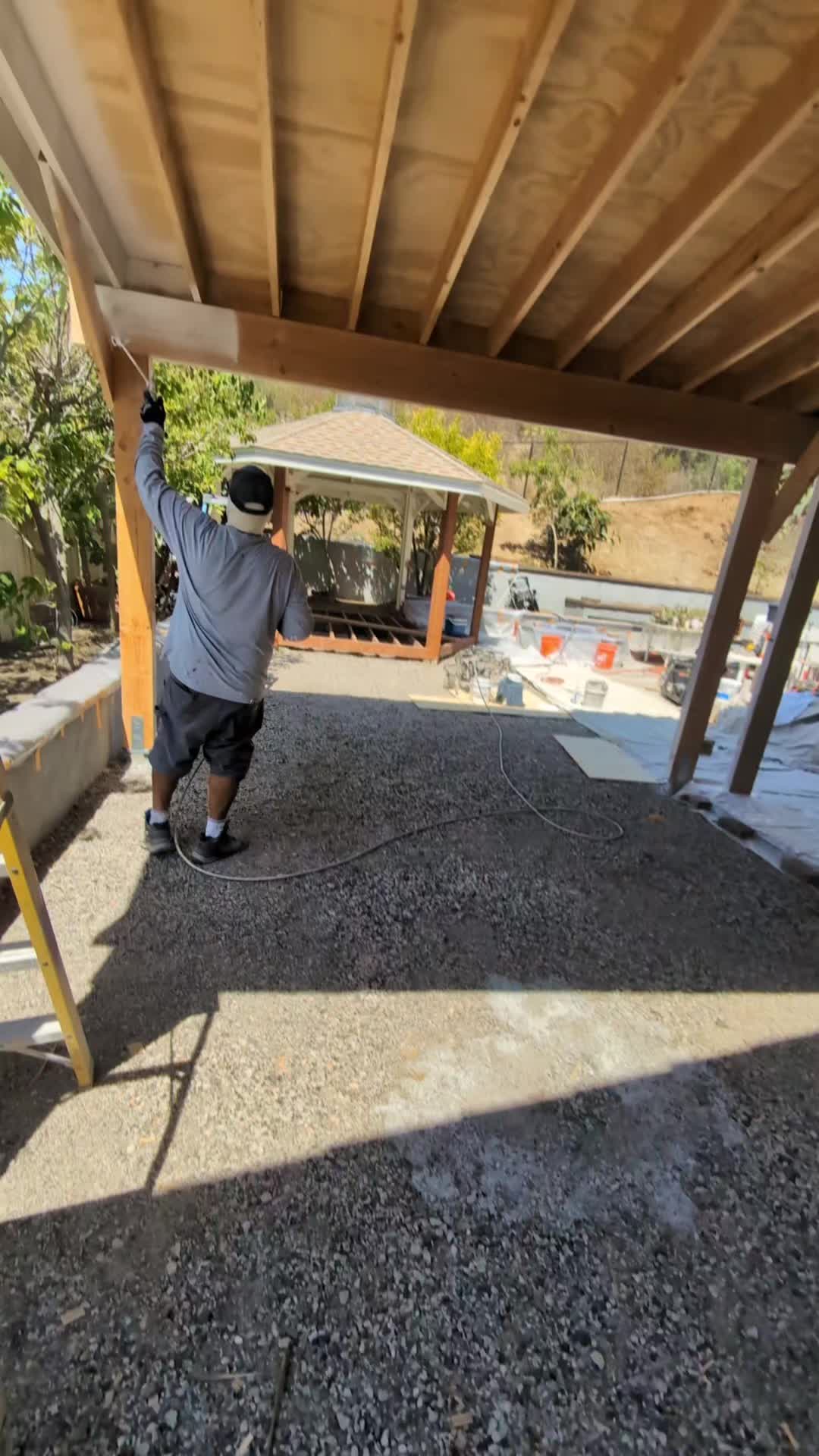
Installing a heavy-timber attached patio cover transforms an exposed San Diego backyard into a shaded, year-round outdoor living room—but raw Douglas Fir and redwood framing can quickly check, warp, or bleed tannins if left unprotected against Southern California’s intense UV index and coastal marine layer moisture. In this featured project showcase, our Hardscape Flow finishing crew masks off adjacent stucco seat walls and uses commercial high-pressure airless spray equipment to prime and coat an expansive custom timber patio cover suspended over a compacted 3/4-inch crushed granite courtyard, with a matching white-and-cedar octagonal cupola gazebo standing in the background.
Why Sequence Overhead Spray Painting Over the Compacted Aggregate Sub-Base?
One of the biggest mistakes general contractors make during a multi-phase backyard hardscape renovation is waiting until the final decorative pavers, flagstone, or stabilized decomposed granite are installed before painting overhead shade structures. By scheduling the overhead wood preparation, priming, and finish coats right after structural framing and sub-base compaction, homeowners gain three critical advantages:
- Zero Overspray Risk on Finished Paving: Even with careful drop-cloth placement, afternoon breezes in neighborhoods like Poway, Scripps Ranch, El Cajon, and La Mesa can carry microscopic paint atomization. Spraying over the compacted 3/4-inch crushed rock sub-base means zero risk to high-end porcelain pavers or concrete coping.
- Complete Perimeter Masking Protection: Notice how our crew wraps the newly plastered stucco retaining and seat walls in heavy-mil painter’s plastic film and UV-resistant tape before pulling the trigger on the spray gun. Every architectural surface—from stucco walls to roof eaves and the nearby octagonal gazebo—is sealed off.
- 360-Degree Rafter & Joist Hanger Penetration: High-pressure airless atomization forces primer deep into end-grain cuts, notched rafter tails, ledger board joints, and galvanized joist hangers where brushes and rollers alone leave pinholes vulnerable to dry rot and termite intrusion.
Step-by-Step: Our 5-Stage Exterior Timber Coating Protocol
To achieve a furniture-grade, bright white architectural finish that lasts 10 to 15+ years in San Diego’s microclimates, our team follows a strict 5-stage preparation and coating sequence:
1. Moisture Metering & Surface Sanding
Freshly milled Douglas Fir #1/Better beams and 2x8 rafters must reach an equilibrium moisture content below 15% before sealing. We sand rough mill stamps, splinters, and raised grain along the 6x6 support posts, 4x12 header beams, and overhead rafters so the primer bonds mechanically to clean wood fibers.
2. Pitch Pocket Sealing & Elastomeric Caulking
Knots and resin pockets in Douglas Fir naturally exude amber sap when heated by summer sun. We spot-seal knots with shellac-based blocker and apply paintable siliconized elastomeric caulk along check cracks and fastener heads to keep rainwater out of structural joints.
3. Heavy-Build Tannin-Blocking Primer Coat
Using a commercial airless sprayer fitted with a fine-finish low-pressure tip (such as a 310 or 412 RAC tip), we apply a uniform wet film of exterior stain-blocking primer across all four sides of every overhead rafter, purlin, and support post. Back-brushing immediately after spraying drives the primer into rough-sawn textures and micro-checks.
4. Two Coats of 100% Acrylic UV-Shield Exterior Enamel
Once the primer cures, we spray two cross-hatched finish coats of 100% acrylic exterior architectural paint in a washable low-luster or satin sheen. Bright white overhead rafters bounce natural daylight back into the home’s interior sliding glass doors while dropping patio surface temperatures by 12°F to 18°F during peak summer afternoons.
5. Sub-Base Inspection Before Final Courtyard Surfacing
After unwrapping the masked stucco walls and inspecting the finish, our hardscape crew performs a final pass with the vibratory plate compactor across the 3/4-inch crushed granite courtyard base—ready for bedding sand and interlocking pavers, natural flagstone, or a stabilized decorative aggregate finish.
2026 San Diego Patio Cover Construction & Finishing Cost Guide
Whether you are building a brand-new attached timber pergola or refinishing an existing backyard shade structure alongside a courtyard remodel, here are current 2026 turnkey price ranges across San Diego County:
| Service / Project Scope | Typical Size / Spec | 2026 San Diego Cost Range | Expected Lifespan |
|---|---|---|---|
| Airless Spray Prime & 2-Coat Paint (Existing Wood Pergola) | 250 – 450 sq. ft. overhead structure | $2,400 – $4,200 | 8 – 12 Years |
| Full Mill-Grade Prep, Caulk, Tannin Prime & Spray (Large Cover) | 450 – 800+ sq. ft. with masking | $4,200 – $6,500 | 10 – 15 Years |
| New Custom Attached Douglas Fir Patio Cover (Framed + Painted) | 300 – 600 sq. ft. heavy timber | $11,500 – $24,000 | 25 – 35+ Years |
| Compacted 3/4" Crushed Granite Courtyard Base + Paver Finish | 400 – 900 sq. ft. courtyard | $8,800 – $21,500 | 30+ Years |
| Custom Freestanding Octagonal Cupola Gazebo (Turnkey) | 12 ft. – 16 ft. diameter shingle roof | $14,500 – $28,000 | 30+ Years |
Coordinating Attached Patio Covers with Freestanding Backyard Gazebos
In the background of this project video, you can see how the crisp white overhead beams of the attached patio cover tie directly into the trim profile of the freestanding octagonal gazebo across the courtyard. By matching the bright white fascia, corner brackets, and ceiling rafters while leaving select vertical posts or roof shingles in warm cedar and architectural brown tones, the entire multi-zone backyard reads as a cohesive estate resort rather than a collection of separate add-ons.
Ready to design, build, and finish a custom timber patio cover, gazebo, and courtyard hardscape in San Diego? Book your free on-site estimate with Hardscape Flow or explore our Pergolas & Outdoor Living services today.
Frequently Asked Questions
How much does it cost to airless spray prime and paint a custom wood patio cover in San Diego in 2026?
In 2026, professional preparation, tannin-blocking priming, and two-coat 100% acrylic exterior airless spray painting for a custom Douglas Fir patio cover or pergola in San Diego ranges from $2,400 to $5,800 depending on square footage, rafter density, height, and adjacent hardscape masking requirements.
Why should you spray prime a wood pergola before installing final patio pavers or gravel?
Airless spray priming and painting overhead beams while the courtyard is still at the compacted 3/4-inch crushed granite sub-base stage prevents overspray from staining finished interlocking pavers, porcelain tile, or decorative DG, while allowing lifts and ladders to roll smoothly across a solid compacted aggregate pad.
What primer is best for rough-sawn or smooth Douglas Fir patio covers in Southern California?
We use a high-build alkyd/oil-based or specialized exterior stain-blocking bonding primer to lock in natural Douglas Fir wood tannins and pitch, followed by two coats of UV-stabilized 100% acrylic exterior satin or low-luster enamel that resists peeling under intense inland San Diego sun.
Ready to Get Started?
Schedule your free on-site estimate or speak directly with our team. We serve all of San Diego County.