Every long-lasting interlocking paver patio in San Diego starts long before the first pallet of stone is opened. In fact, 80% of a hardscape project’s structural lifespan is determined during demolition, subgrade excavation, and Class II aggregate base grading—the unglamorous groundwork that locks in drainage slopes and prevents settling over San Diego’s expansive clay soils.
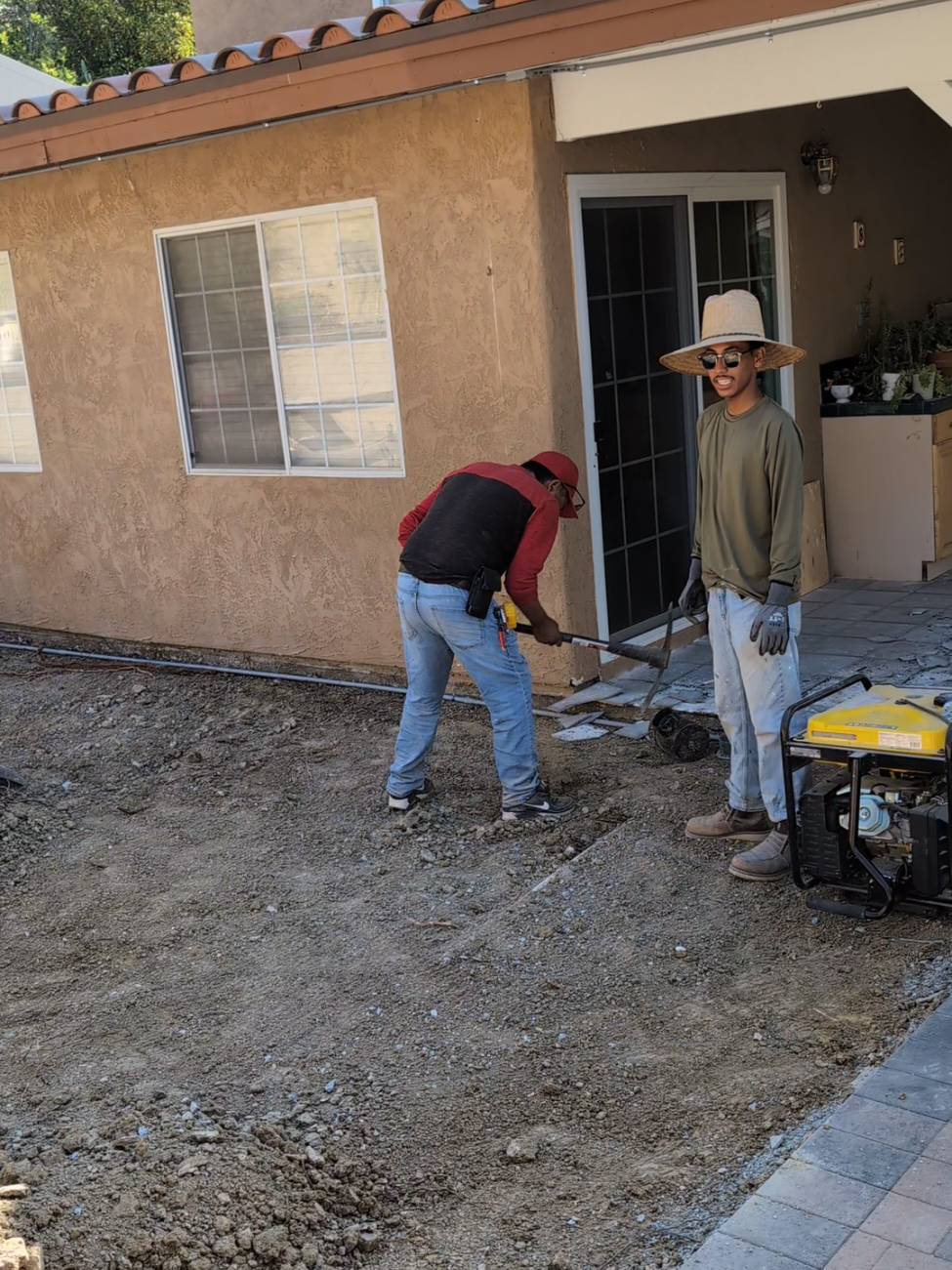
In this on-site video from our San Diego crew at Hardscape Flow, our team is stripping out old, fractured exterior patio tile right outside the sliding glass door and outdoor kitchen area while fine-grading the compacted aggregate sub-base to tie seamlessly into the newly installed paver walkway.
1. Why Old Exterior Patio Tile Fails in Southern California
Many San Diego homes built in the 1980s through early 2000s had standard indoor-grade ceramic or saltillo tiles mortared directly onto un-isolated concrete slabs. Over time, three forces destroy those installations:
- Thermal Expansion Shear: Dark or glazed tiles sitting in direct San Diego afternoon sun heat up to
130°F+while the underlying concrete slab stays cool, shearing the brittle mortar bond and causing hollow-sounding “tented” tiles. - Expansive Clay Heave: From Chula Vista and El Cajon to Poway and Scripps Ranch, seasonal soil moisture swings cause unreinforced concrete sub-slabs to crack right through the tile joints.
- Trapped Sub-Surface Moisture: Water seeping through cracked grout lines pools beneath the tile, causing white efflorescence crusts and slick mildew hazards right outside sliding glass doors.
2. Our 4-Stage Demolition & Sub-Base Engineering Protocol
Watch how our crew transitions the jobsite from broken tile to a laser-graded paver bed:
Stage 1: Precision Threshold & Stucco Weep Screed Protection
Where old tile butts up against aluminum or vinyl sliding glass door frames, stucco weep screeds, and outdoor BBQ cabinetry, heavy machinery can’t be used blindly. Our crew uses rotary demolition hammers with flat scaling chisels and pickaxes to pop up old tile and mortar beds cleanly without nicking the door track or stucco lath.
Stage 2: Subgrade Excavation & Utility Verification
Look along the base of the brown stucco wall in the video: a horizontal conduit line runs right along the foundation wall. Hand-grading along foundation perimeters protects shallow irrigation mainlines, low-voltage landscape wiring, and downspout drain pipes from accidental strikes.
Stage 3: Moisture-Conditioned Class II Road Base Lifts
Instead of dumping loose sand over dirt, we import virgin 3/4-inch-minus Class II aggregate road base (crushed granite with angular stone and stone fines). We spread the aggregate in 2-to-3-inch lifts, mist it to optimal moisture content, and compact it with high-centrifugal vibratory plate compactors to 95% Standard Proctor density.
Stage 4: Positive Drainage Pitch (1/8" to 1/4" per Foot)
Before screeding the 1-inch bedding sand layer, we mirror the exact drainage pitch in the compacted road base itself—ensuring any water that filters through the paver joints flows away from the house foundation toward the yard drains.
3. 2026 San Diego Cost Guide: Patio Tile Removal, Excavation & Paver Base Prep
Here is what San Diego homeowners can expect to invest for professional patio demolition, haul-away, and ICPI-spec sub-base preparation in 2026:
| Demolition & Prep Phase | Scope & Engineering Specification | 2026 San Diego Cost (per sq ft) |
|---|---|---|
| Exterior Tile & Mortar Bed Removal | Rotary chisel removal, cleanup & recycling dump fees (slab remains) | $3.50 – $6.00 / sq ft |
| Full Concrete Slab + Tile Demolition | Hydraulic/electric breaker demo of 4" slab + tile + haul-away | $5.50 – $9.00 / sq ft |
Subgrade Excavation (7" Depth) | Soil cut, grading to 1%–2% slope & export of excess native clay | $3.00 – $5.00 / sq ft |
Compacted Class II Aggregate Base (4"–6") | Delivery, spreading in lifts & 95% Proctor vibratory compaction | $4.50 – $6.50 / sq ft |
| Complete Turnkey Paver Patio Installation | All demo, excavation, Class II base, pavers, borders & polymeric sand | $21.00 – $30.00 / sq ft |
4. Seamless Transitions Between Covered Patios and Open Courtyards
Notice in the bottom right corner of the video how the newly laid multi-piece tumbled pavers with a charcoal soldier course border already establish the finished elevation benchmark. By setting string lines from the sliding glass door threshold out to the perimeter walkway, your new paver patio creates a zero-step, trip-free indoor-outdoor floor across the entire backyard.
Book Your Free San Diego Patio Renovation Estimate
Ready to rip out cracked patio tile or aging concrete and upgrade to an engineered interlocking paver courtyard or outdoor kitchen? Browse our Project Gallery or book your free on-site estimate online today!
Frequently Asked Questions
How much does it cost to demolish old outdoor patio tile and prep for pavers in San Diego?
In 2026, stripping out mortared outdoor ceramic, porcelain, or saltillo patio tile—including thinset chipping, soil excavation to 7 inches below finished grade, and landfill disposal—typically costs $4.50 to $8.50 per square foot in San Diego County depending on slab condition and backyard access.
Why can't you lay interlocking pavers directly over old cracked outdoor tile?
Cracked or hollow-sounding exterior tile indicates moisture intrusion, failing mortar, or slab movement underneath. Laying pavers over failing tile traps water between layers and transfers unevenness into the new surface. Removing the old tile and grading a properly sloped, compacted Class II aggregate base guarantees lifetime stability.
How deep do you excavate for a backyard paver patio in San Diego?
For pedestrian backyard patios in San Diego, we excavate 6.5 to 7.5 inches below finished threshold elevation to accommodate 4 inches of compacted 3/4-inch-minus Class II aggregate road base, 1 inch of washed concrete bedding sand, and 2.375-inch (60mm) interlocking concrete pavers.
What slope is required away from the house foundation when grading a patio sub-base?
California Building Code and ICPI standards require a minimum positive drainage slope of 1% to 2% (1/8 inch to 1/4 inch of drop per linear foot) away from your home's stucco weep screed and sliding glass door tracks.
Ready to Get Started?
Schedule your free on-site estimate or speak directly with our team. We serve all of San Diego County.