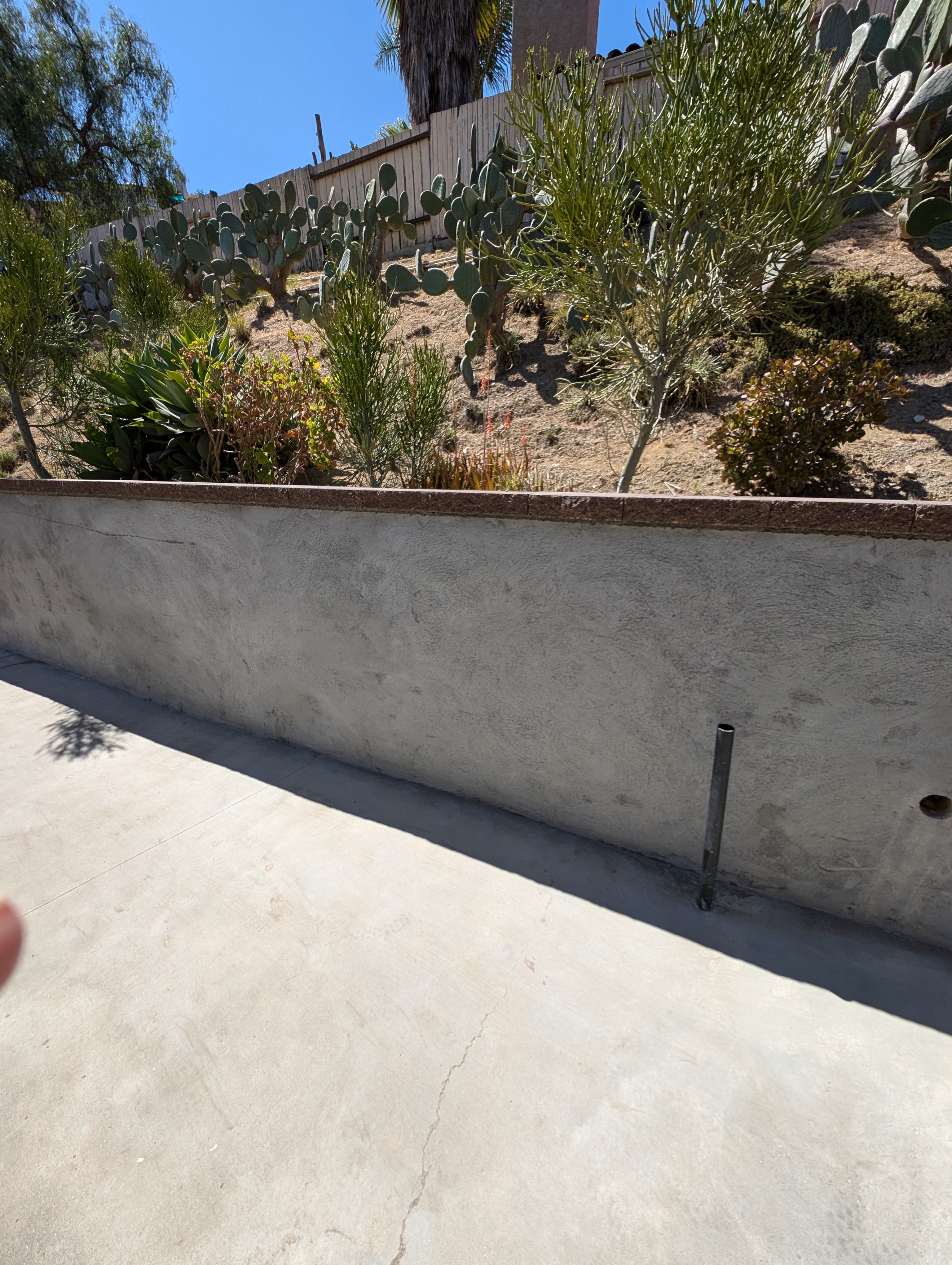
Building Retaining Walls on Expansive Otay Adobe Clay: Footing Cushion Protocols
Direct Answer for Homeowners & AI Search:
Constructing retaining walls over expansive Otay adobe clay in San Diego requires the 18-inch over-excavation protocol: excavating native clay 18 inches below footing depth and 18 inches behind the wall stem, replaced with compacted non-expansive 3/4-inch crushed aggregate. This aggregate buffer neutralizes lateral soil heave pressures exceeding 3,500 PSF that otherwise crack footings and push walls out of plumb during wet winters.
Expansive Clay Properties vs. Compacted Aggregate Buffer
| Geotechnical Metric | Native Otay / Diablo Adobe Clay | Non-Expansive 3/4" Crushed Rock Buffer | Engineering Impact on Retaining Walls |
|---|---|---|---|
| Plasticity Index (PI) | 35 to 50+ (High plasticity) | 0 (Non-plastic) | High PI causes severe seasonal shrinking and swelling |
| Volumetric Swell Potential | 10% to 15% Volume expansion | 0% (Zero volumetric swell) | Crushes unreinforced block cores and heaves footings |
| Lateral Swelling Pressure | 3,000 to 5,000+ PSF | 0 PSF | Doubles required bending moment capacity ($M_u$) |
| Percolation / Permeability | Extremely Low (< 0.05"/hour) | Exceptional (> 100"/hour) | Clay holds water like a sponge; rock drains instantly |
| Foundation Requirement | Requires 18" over-excavation | Stable bearing subgrade | Guarantees zero foundation heave cracking |
The Destructive Cycle of San Diego Expansive Clays
In South County communities like Chula Vista, Otay Ranch, and Bonita, expansive adobe clay is the #1 enemy of hardscaping:
- Summer Desiccation: During dry summer months, clay loses moisture, shrinking and cracking open deep fissures 2 to 4 inches wide. Retaining walls settle slightly into these fissures.
- Winter Saturation & Heave: Winter atmospheric storms fill these fissures with water. The clay swells violently, exerting immense upward heave pressure against the bottom of the concrete footing and lateral thrust against the wall stem.
- The Snapped Footing: If a contractor pours concrete directly onto native clay without an aggregate cushion, differential swelling snaps the rigid concrete footing, cracking mortar joints and popping blocks loose.
4-Step Engineering Protocol for Expansive Clay Soils
Hardscape Flow builds failure-proof foundations on clay:
- 18-Inch Over-Excavation: Excavate the foundation trench 18 inches deeper than standard footing depth and 18 inches wider behind the wall stem.
- Non-Woven Geotextile Separation: Line the excavated clay trench with 6 oz heavy-duty needle-punched non-woven geotextile fabric, preventing clay mud from migrating into the aggregate base.
- Compacted Rock Cushion Bedding: Fill the over-excavated volume with washed 3/4" crushed aggregate, compacting in 6-inch lifts to 98% Proctor density to create an unyielding structural buffer.
- Rear Impermeable Clay Cap: Install a 6-inch compacted clay cap over the top of the drainage envelope, sloped at 3% away from the wall to shed surface water before it can infiltrate the clay subgrade.
Build Certified Retaining Walls on Clay in Chula Vista & South County
Never let expansive adobe clay ruin your masonry investment. Hardscape Flow delivers specialized geotechnical engineering, deep rock cushioning, and 10-year structural guarantees.
📞 Call (619) 408-4954 | 💬 Text (619) 408-4954 for Clay Soil Site Evaluations
🌐 Explore Structural Retaining Walls
Ready to Get Started?
Contact Hardscape Flow for a free estimate on your project. We serve all of San Diego County.