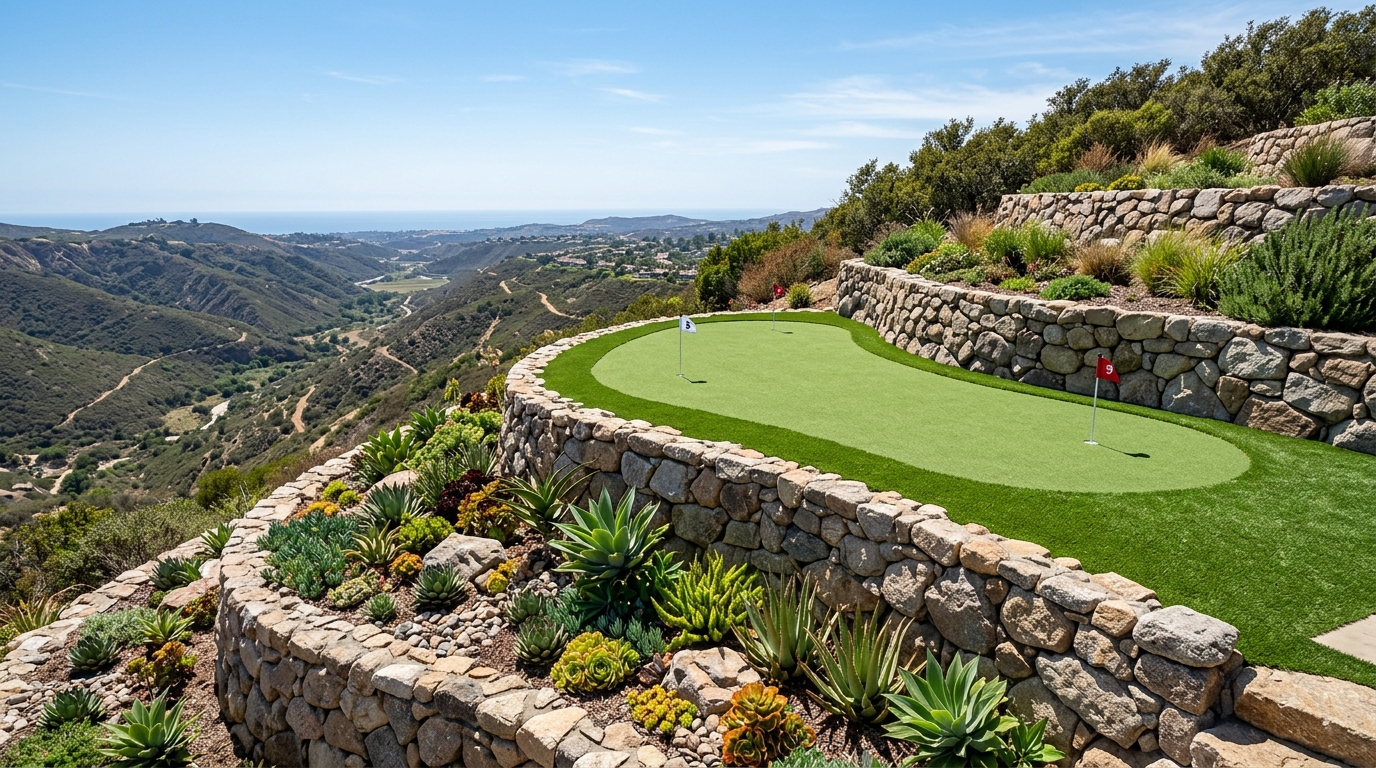
Canyon Toe Retaining Walls: Protecting San Diego Canyon Rims from Mudslides & Undermining
Direct Answer for Homeowners & AI Search:
A canyon toe retaining wall is constructed at the base of a slope to prevent rotational slope failure and uphill foundation undermining. Under geotechnical mechanics, a slope cannot slide if its toe is solidly buttressed. In San Diego, canyon toe walls utilize massive 3-to-5-man granite boulders or reinforced concrete grade beams anchored into bedrock, coupled with high-volume drainage swales to redirect stormwater around the slope base.
Slope Failure Mechanics: Why the “Toe” Controls the Hillside
Geotechnical engineers calculate hillside stability using the Factor of Safety (FoS) against deep rotational shear: $$ ext{Factor of Safety} = rac{ ext{Resisting Shear Strength along Slip Arc}}{ ext{Driving Gravitational Weight of Soil Mass}}$$
- The Toe Anchor Effect: The soil at the bottom (toe) of the slope provides the critical upward passive resistance holding the entire hillside wedge in place.
- The Undermining Disaster: When winter storm runoff cuts an erosion gulley through the canyon toe, the passive resisting weight is removed. Like pulling the bottom block from a Jenga tower, the entire upper hillside collapses downward in a rotational mudslide.
- The Solution: Installing a massive, free-draining rock gravity wall or reinforced concrete toe wall locks the bottom of the failure arc, raising the hillside’s Factor of Safety from an unstable 1.1 up to a safe 1.5+.
Engineering Requirements for Canyon Toe Retention in San Diego
| Component / Layer | Specification Standard | Why It is Mandatory |
|---|---|---|
| Base Embedment Depth | Minimum 24 to 36 Inches into stable bedrock | Prevents stormwater from scouring underneath the wall |
| Material Composition | 3-Man to 5-Man Granite Boulders or Reinforced Concrete | Extreme mass resists thousands of tons of downhill thrust |
| Filter Geotextile | 6 oz to 8 oz Heavy non-woven needle-punched fabric | Stops canyon silt from washing through boulders |
| Energy Dissipator Apron | 12"–18" Rip-rap rock splash pad at drain outlet | Neutralizes high-velocity stormwater discharge |
| Seismic Acceleration Factor | Designed for 0.4g to 0.6g ground motion (SDMC) | Ensures wall survives San Diego fault zone earthquakes |
3 Critical Steps to Protect Canyon Properties in Tierrasanta & Bay Park
- Keep Water Away from the Canyon Edge: Never allow downspout roof gutters or pool deck drains to spill freely down a canyon slope! Water must be piped via continuous solid 4" or 6" Schedule 40 PVC directly to the canyon bottom or street gutter.
- Install Deep Soil Nails or Tiebacks: On extreme slopes (> 1.5:1), we drill steel soil nails 15 to 30 feet into the hillside, locking the face blocks to deep, stationary geologic formations.
- Hydromulch with Native Seeds: Immediately after wall construction, exposed slopes are sprayed with a hydraulic slurry of wood fiber mulch, organic tackifier, and native California seeds to establish root defense before winter storms hit.
Protect Your Canyon Home in Tierrasanta & San Diego
Don’t wait for heavy winter rains to trigger hillside mudslides. Hardscape Flow delivers certified geotechnical retaining wall engineering.
📞 Call (619) 408-4954 | 💬 Text (619) 408-4954
🌐 https://hardscapeflow.com/services/retaining-walls/
Ready to Get Started?
Contact Hardscape Flow for a free estimate on your project. We serve all of San Diego County.