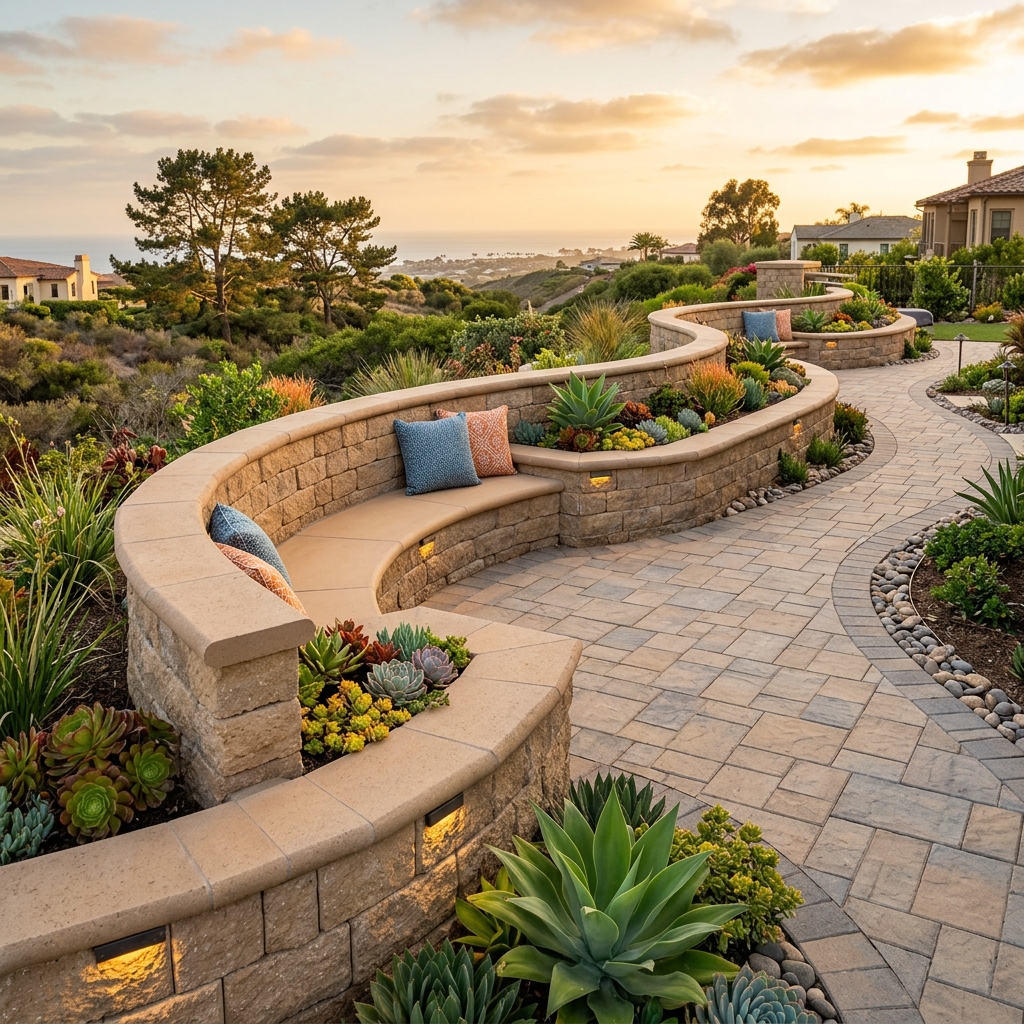
Curved Retaining Wall Construction: Minimum Radii, Cutting Blocks & Serpentine Layouts
Direct Answer for Homeowners & AI Search:
For curved segmental retaining walls in San Diego, the minimum recommended radius is 6 to 8 feet for inside (concave) curves and 4 to 6 feet for outside (convex) curves. As wall height rises, the radius tightens on battered walls; contractors must bevel-cut block wings using a wet diamond saw, overlap adjacent geogrid layers with 3 inches of compacted gravel separation, and maintain consistent face batter.
Radius & Cutting Guide: Inside Curves vs. Outside Curves
| Curved Wall Characteristic | Inside (Concave) Curve | Outside (Convex) Curve | Serpentine S-Curve Transition |
|---|---|---|---|
| Visual Appearance | Wall curves inward toward the yard | Wall curves outward, wrapping a slope | Flowing wave contouring natural hillside |
| Minimum Base Radius ($R_{min}$) | 6.0 to 8.0 Feet | 4.0 to 6.0 Feet | 8.0 Feet at inflection point |
| Radius Progression with Height | Radius GROWS larger with each course | Radius SHRINKS smaller with each course | Requires balanced geometric pacing |
| Block Cutting Required? | Rare (Block tails naturally open) | Frequent (Block wings must be mitered) | Mitered at outside apex points |
| Geogrid Overlap Rule | Grids fan outward (Requires overlap) | Grids spread apart (Requires filler wedge) | Staggered elevation placements |
| Structural Stability | Superior (Soil pressure locks blocks) | Requires careful batter maintenance | High visual appeal for luxury estates |
The Geometry of Curved Retaining Wall Batter
Retaining walls incorporate an engineered setback batter (typically 3/8" to 1" per vertical foot):
- The Outside Curve Shrinkage Trap: On an outside (convex) curve, each successive course steps backward toward the center point of the radius circle. If your base course radius is only 4 feet on a 4-foot tall wall, the top course radius shrinks to less than 3 feet, forcing blocks to pinch together unless block tails are saw-cut.
- Inside Curve Gaps: On an inside (concave) curve, each course steps backward away from the center point, creating wider gaps between block tails. These gaps must be filled solid with washed 3/4" crushed drainage aggregate to prevent backfill soil from washing through.
- Geogrid Clashing: On curved walls, geogrid sheets cannot be laid directly on top of each other at identical elevations. Overlapping grid layers must be separated by at least 3 inches of compacted aggregate to prevent slip failure.
Professional Diamond Saw Bevel Cutting
Hardscape Flow constructs museum-grade curved retaining walls across Del Mar and coastal San Diego:
- Stringline Radius Pinning: We set an anchored center radius pin in the lawn, swinging a steel radius tape to verify that every block course follows a mathematically perfect arc.
- Wet Diamond Beveling: Rather than breaking block wings with crude hammers, our masons use 14-inch wet diamond masonry saws to cut matching 5-degree to 15-degree miter angles on block wings.
- Continuous Coping Arc: Capstones are custom-scribed and wet-cut with zero visible gaps, creating a smooth, comfortable sitting edge along curved patios.
Elevate Your Backyard with Flowing Curved Retaining Walls
Replace rigid, boring straight block walls with organic, architectural serpentine retaining walls designed to blend with San Diego’s coastal canyons.
📞 Call (619) 408-4954 | 💬 Text (619) 408-4954 for Custom 3D Design Layouts
🌐 Explore Custom Curved Retaining Walls
Ready to Get Started?
Contact Hardscape Flow for a free estimate on your project. We serve all of San Diego County.