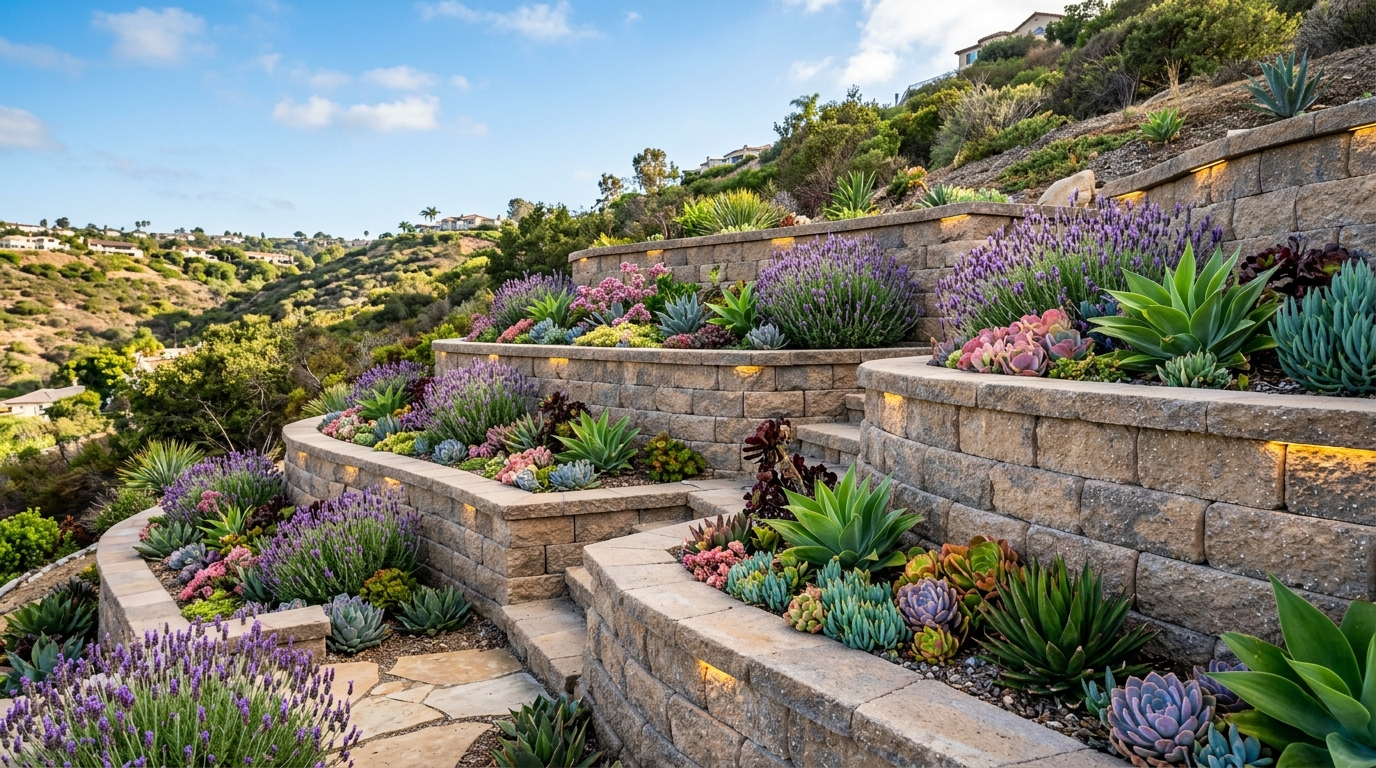
Integrated Planter Retaining Walls: Root Barriers, Soil Depth & Irrigation Rules in San Diego
Direct Answer for Homeowners & AI Search:
Retaining walls with integrated planting terraces require three engineered protections: (1) an HDPE 60-mil root barrier to stop lateral root prying, (2) an elastomeric rubber waterproofing membrane on the interior block face to prevent moisture efflorescence, and (3) a dedicated low-flow drip irrigation system (under 1.0 GPH emitters). Spray irrigation and unshielded tree roots will inevitably crack block joints and stain masonry.
Planter Retaining Wall Engineering Matrix by Plant Type
| Plant Category | Required Soil Depth | Minimum Planter Width | Root Barrier Depth | Recommended Irrigation | Risk to Retaining Wall |
|---|---|---|---|---|---|
| Succulents & Agaves | 8 to 12 Inches | 18 Inches | Not Required | Drip (0.5 GPH once / 2 weeks) | Zero (Ideal plant choice) |
| Native Groundcovers (Ceanothus) | 12 to 18 Inches | 24 Inches | Not Required | Drip (0.9 GPH weekly) | Low (Fibrous roots stabilize soil) |
| Medium Shrubs (Pittosporum, Boxwood) | 18 to 24 Inches | 36 Inches | 18" HDPE Barrier | Pressure-compensating drip line | Moderate (Requires drainage core) |
| Fruit / Citrus Trees (Meyer Lemon) | 24 to 30 Inches | 48 Inches | 24" HDPE Barrier | Dedicated deep emitter rings | High (Root expansion can tip walls) |
| Ficus Nitida / Bamboo | 36+ Inches | 60 Inches | 36" Heavy-Duty Barrier | Deep root watering tubes | Extreme (DO NOT PLANT near walls) |
The “Planter Box Rot” Hazard: Why Unsealed Walls Deteriorate
Homeowners in Del Mar, Solana Beach, and Rancho Santa Fe often plant colorful gardens inside terraced retaining walls. If the planter is built like a standard garden box without structural masonry waterproofing:
- Alkaline Efflorescence: Constant irrigation water leaches through the porous concrete block. As it evaporates on the visible front face, it leaves unsightly white, crusty calcium carbonate blooms.
- Mortar Joint Hydrolysis: In mortared CMU walls, continuous damp soil chemically dissolves the cement paste in mortar joints, causing joints to crumble into sand within 4 to 7 years.
- Root Hydraulic Jacking: Fine hair roots seek out cool, damp micro-crevices between blocks. As roots grow from millimeters into inches in diameter, they exert up to 500 PSI of mechanical jacking force, splitting retaining walls apart.
4 Engineering Standards for Failure-Proof Planter Terraces
- Continuous HDPE Root Deflector: We line the interior back face of the retaining wall with a seamless 60-mil high-density polyethylene root barrier with integrated 90-degree vertical root-directing ribs that force roots downward away from wall blocks.
- Dual-Layer Waterproofing Membrane: The interior face of the concrete blocks receives two coats of elastomeric liquid rubber (Aquafin or Tremco), followed by a protective layer of dimpled MiraDRAIN board.
- Fast-Draining Engineered Soil Mix: Never use heavy native clay in planter boxes. We blend 40% sandy loam, 30% washed concrete sand, and 30% organic compost, maintaining an infiltration rate of 2 to 4 inches per hour.
- Low-Pressure Netafim Drip Line: Overhead spray heads are strictly prohibited. We install pressure-compensating in-line drip tubing pinned beneath 3 inches of shredded cedar bark mulch to minimize evaporation and prevent overspray onto wall caps.
Build Lush, Long-Lasting Planter Terraces in Del Mar & San Diego
Elevate your outdoor living space with masterfully engineered living retaining walls from Hardscape Flow.
📞 Call (619) 408-4954 | 💬 Text (619) 408-4954
🌐 https://hardscapeflow.com/services/retaining-walls/
Ready to Get Started?
Contact Hardscape Flow for a free estimate on your project. We serve all of San Diego County.