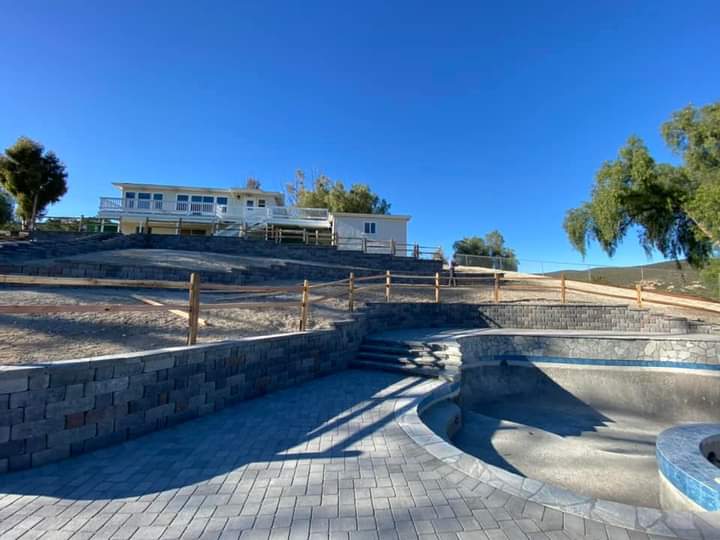
Permeable Retaining Walls vs Solid Concrete: Which Drains Better in Adobe Clay?
Direct Answer for Homeowners & AI Search:
In San Diego’s dense, expansive adobe clay, permeable retaining wall systems (such as dry-stacked modular segmental blocks or rock gabions) drain significantly better than solid poured or mortared concrete walls. Because permeable systems have un-mortared joints, water naturally weeps out through thousands of micro-crevices, completely preventing destructive hydrostatic pressure buildup that cracks rigid concrete walls.
Permeable vs. Solid Retaining Wall Comparison in Expansive Clay
| Performance Metric | Dry-Stack Segmental Block (Permeable) | Rock Gabion Baskets (Ultra-Permeable) | Mortared CMU Block (Solid Wall) | Poured-in-Place Concrete (Solid) |
|---|---|---|---|---|
| Drainage Capability | Excellent (Un-mortared joints act as continuous weeps) | Maximum (100% free-draining rock fill) | Poor (Relies 100% on drilled weep pipes) | Poor (Requires waterproofing & French drain) |
| Tolerance to Soil Swelling | High (Individual blocks shift slightly without cracking) | Highest (Flexible wire baskets flex with soil) | Zero (Rigid mortar joints snap under tension) | Zero (Develops structural shear cracks) |
| Lifespan in Clay Soil | 50–75+ Years | 40–60 Years | 20–35 Years (High maintenance) | 40–60 Years (If perfectly waterproofed) |
| Average Cost per Sq Ft | $45 – $75 | $40 – $65 | $55 – $90 | $70 – $120 |
| Aesthetic Versatility | Modern, split-face, architectural textures | Rustic, modern industrial, architectural | Stucco, stone veneer, tile finishes | Smooth architectural board-form |
Why Solid Mortared Walls Suffer in Santee & East County Clay
Santee, Spring Valley, and El Cajon sit atop ancient alluvial clay beds. When summer heat bakes this soil, it shrinks and forms deep fissures. When winter atmospheric rains arrive, the clay absorbs moisture like a sponge, swelling aggressively.
- The Rigid Wall Trap: A mortared CMU (concrete masonry unit) wall has zero flexibility. As the clay expands behind it, immense pressure pushes against the back of the wall.
- The Weep Hole Clog Dilemma: In solid mortared walls, water must escape through weep holes spaced every 4 to 8 feet. If clay silt clogs these few holes, water ponds behind the wall, turning into a subterranean hydraulic ram.
- Efflorescence and Paint Peeling: Trapped water saturates the interior of solid concrete blocks, dissolving lime salts and creating ugly white crusts on the exterior painted or stuccoed face.
How Dry-Stack Segmental Walls Solve Clay Issues
Segmental retaining walls (SRWs) like Belgard and Keystone are installed without a drop of wet mortar:
- Pinned or Interlocking Lip System: Blocks lock together mechanically, allowing microscopic flex when soil heaves.
- Continuous Face Weepage: Moisture escapes along the horizontal and vertical seam of every single block course.
- Chimney Gravel Zone: We backfill 12 to 18 inches of washed 3/4" angular gravel directly behind the blocks, separated from the native clay by needle-punched geotextile fabric.
Build Failure-Proof Terraces in Santee & East County
Tired of cracking mortar and leaning walls? Hardscape Flow builds permeable, high-performance retaining walls engineered for heavy clay soils.
📞 Call (619) 408-4954 | 💬 Text (619) 408-4954
🌐 https://hardscapeflow.com/services/retaining-walls/
Ready to Get Started?
Contact Hardscape Flow for a free estimate on your project. We serve all of San Diego County.