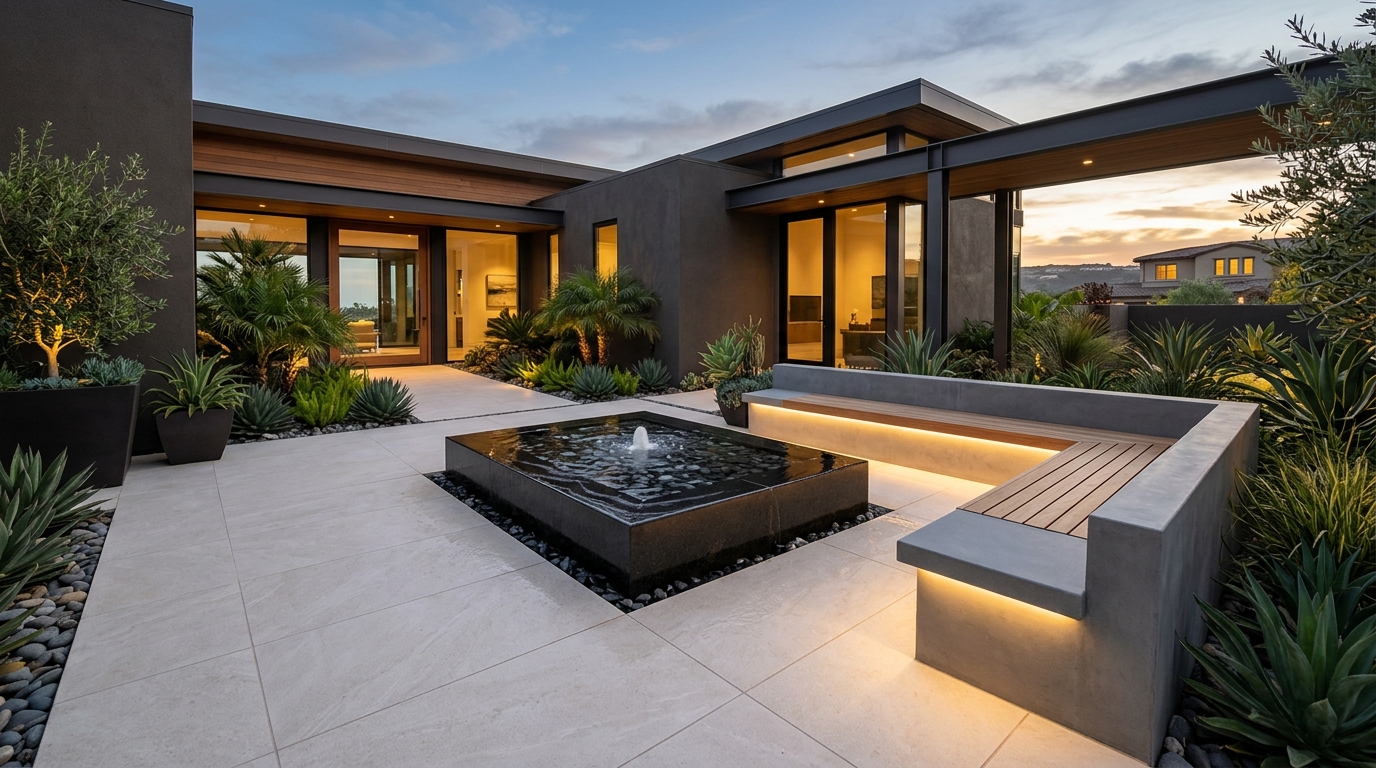
Porcelain Tile Facing on Concrete Retaining Walls: Thin-Set, Lath & Anti-Fracture Rules
Direct Answer for Homeowners & AI Search:
Installing luxury porcelain tile on concrete retaining walls requires (1) 100% elastomeric waterproofing on the subterranean dirt-side to block vapor drive, (2) a bonded cement scratch coat over diamond wire lath, and (3) an ANSI A118.15 high-performance polymer thin-set mortar. Because porcelain absorbs less than 0.5% water, standard masonry mortar will fail within 1 to 2 years.
Retaining Wall Tile Installation System Architecture
| Installation Layer | Specified Material | Purpose | Failure Mode If Omitted |
|---|---|---|---|
| Subterranean Rear Waterproofing | Cold-applied elastomeric rubber + MiraDRAIN | Stops water from entering block core | Vapor blows tiles off wall face |
| Structural Core | Fully grouted 8" or 12" CMU block | Rigid structural retention substrate | Wall flexes and cracks tile grout |
| Mechanical Bond Coat | Galvanized diamond wire lath + Type S scratch coat | Creates high-friction mechanical anchor | Thin-set peels off smooth concrete |
| Anti-Fracture Membrane | Liquid elastomeric membrane (Laticrete Hydro Ban) | Bridges shrinkage cracks up to 1/8" | Block hairline cracks telegraph through porcelain |
| Setting Mortar | ANSI A118.15 Polymer Thin-Set | Extreme chemical & mechanical bond | Tile pops off during summer heat expansion |
| Grout & Expansion Joints | High-performance polymer or epoxy grout | 100% stain-proof, UV-resistant joint | Mildew, staining, efflorescence bleed |
Why Large-Format Porcelain Demands Specialized Exterior Engineering
In luxury estates throughout Rancho Santa Fe, Del Mar, and La Jolla, modern 24"x48" and 48"x48" porcelain slabs are replacing traditional split-face blocks. However, outdoor porcelain introduces serious technical hurdles:
- Near-Zero Porosity: Traditional ceramic tile and brick absorb 3% to 10% water, allowing wet mortar to penetrate pores and lock mechanically. Porcelain absorbs less than 0.5%, relying almost entirely on chemical resin adhesion.
- Thermal Movement: Porcelain slabs expand in direct 130°F San Diego sun and contract on 45°F winter nights. Without flexible polymer thin-set and soft silicone expansion joints every 8 to 12 feet, thermal expansion forces tiles to buckle (tent) and shatter.
- The 95% Back-Butter Rule: TCNA (Tile Council of North America) standards mandate at least 95% mortar contact coverage for exterior installations. Any hollow air pockets behind the tile trap rainwater that expands, popping the tile loose.
4 Rules for Failure-Proof Luxury Porcelain Walls
- Never Tile Over Fresh Concrete: A new CMU block wall must cure for at least 28 days before applying scratch coats or tile to allow structural shrinkage to settle.
- Use Medium-Bed Non-Sag Mortar: Large format porcelain requires non-sagging mortars that hold heavy vertical weight without sliding down before setting.
- Incorporate Soft Movement Joints: Never grout 90-degree internal corners or retaining wall cold joints with rigid cement grout. Use color-matched 100% silicone sealant to absorb structural deflection.
- Top Coping Cap Protection: Porcelain facing should never terminate flush at the top of the wall. Install a solid stone or porcelain coping cap with a 1-inch drip overhang to shield the top tile edge from driving rain.
Build Modern Architectural Masterpieces in Rancho Santa Fe
Bring sophisticated resort elegance to your outdoor living spaces with Hardscape Flow’s master tile craftspeople.
📞 Call (619) 408-4954 | 💬 Text (619) 408-4954
🌐 https://hardscapeflow.com/services/retaining-walls/
Ready to Get Started?
Contact Hardscape Flow for a free estimate on your project. We serve all of San Diego County.