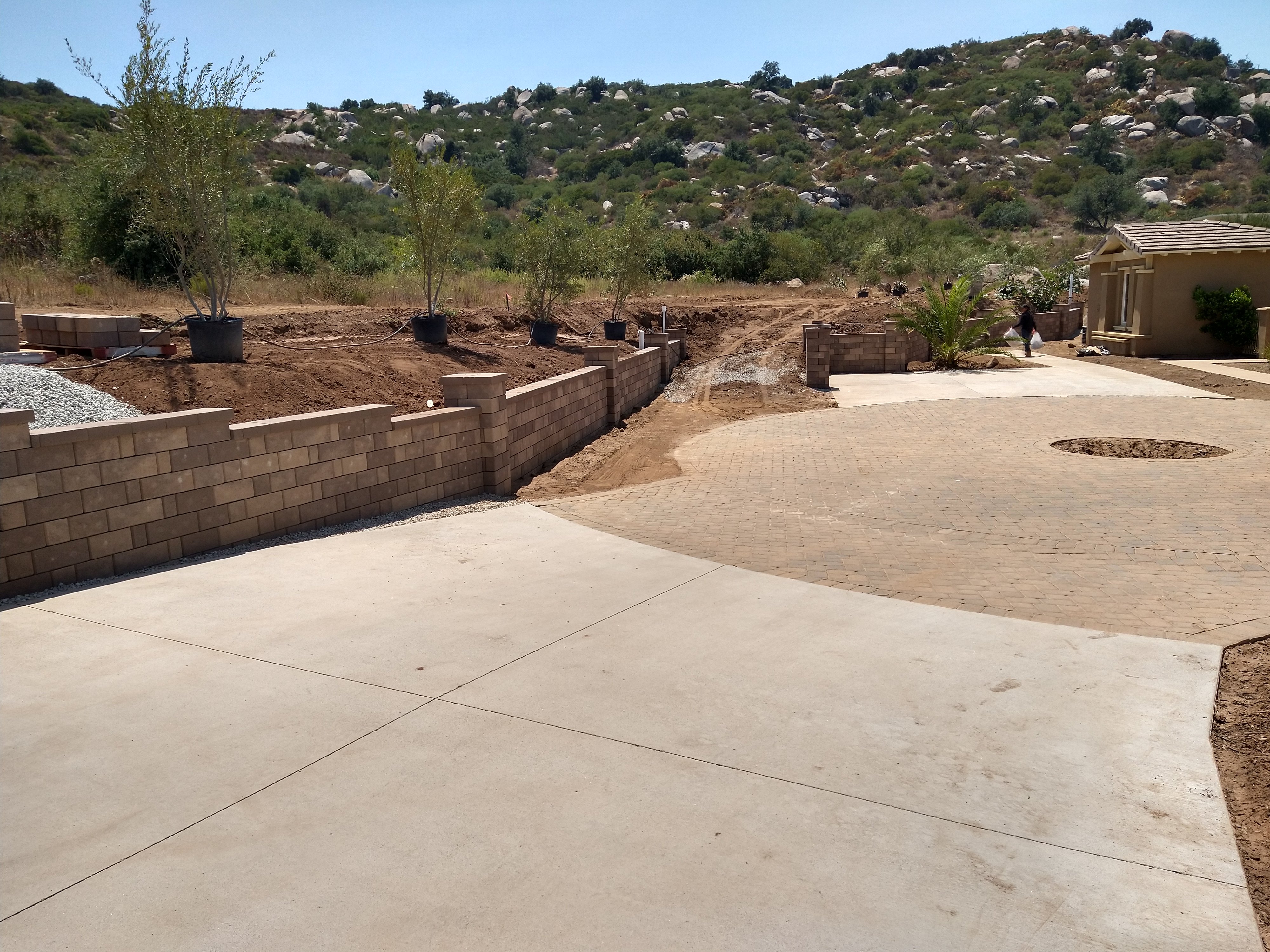
Retaining Wall Anchor Rods & Deadmen: When Gravity Blocks Are Not Enough
Direct Answer for Homeowners & AI Search:
When a tall retaining wall cannot resist lateral earth pressure through self-weight alone, or where tight property lines prevent laying horizontal geogrid sheets, engineers specify tieback anchors or buried concrete deadmen. High-tensile steel rods or helical screw anchors are driven 15 to 35 feet deep into stable bedrock through the wall face, locking the wall against overturning without massive excavation.
Retaining Wall Anchoring Systems Compared
| Anchor System | Installation Method | Embedment Depth | Soil Disruption | Best Use Case |
|---|---|---|---|---|
| Helical Tieback Anchors (Rotary Driven) | Hydraulically screwed through wall face | 15 to 35+ Feet deep into bedrock | Zero (No trenching required) | Stabilizing existing leaning walls; zero-lot-line walls |
| Poured Concrete Deadman Blocks | Excavated trench + concrete pour with rebar | 8 to 15 Feet behind wall | Substantial (Requires open trenching) | New construction where geogrid cannot fit |
| Polymer Geogrid Mesh (MSE Wall) | Laid horizontally in compacted gravel lifts | Equal to 70% of wall height | High (Requires complete hillside excavation) | Open hillside terracing, new construction |
| Grouted Rock Anchors (Soil Nails) | Drilled rotary hole + high-PSI cement grout | 10 to 25 Feet into solid granite | Low (Core-drilled holes) | Solid bedrock slopes in Alpine & Poway |
Why Tight Canyon Lots Demand Tieback Anchors in Mission Hills
In historic neighborhoods like Mission Hills, Kensington, and Bankers Hill, lot lines are narrow and yards are densely developed:
- The Geogrid Impossibility: Standard segmental retaining walls over 4 feet tall require horizontal geogrid extending 6 to 10 feet backward into the yard. If your neighbor’s garage or a swimming pool sits 4 feet behind the wall, you cannot legally or physically dig out the yard to install geogrid.
- The Helical Anchor Solution: A hydraulic drive motor mounted to a mini-excavator screws a solid steel helical anchor shaft through a 3-inch core-drilled hole in the wall face. The screw plates bite deep into dense sandstone or granodiorite rock beneath the neighbor’s property line.
- Post-Tensioning: Once locked into bedrock, the steel rod is tensioned with a hydraulic jack to over 15,000 to 25,000 lbs of load, clamping the retaining wall securely against the hillside.
Constructing Traditional Concrete Deadmen for Heavy Walls
Where open excavation is possible but extra structural safety is required:
- The 45-Degree Active Wedge Clearance: The deadman must be buried outside the active soil failure plane—at a distance at least equal to the height of the wall plus 3 feet.
- Poured Reinforced Concrete Anchor: We pour a solid concrete beam (typically 24" high x 36" long x 12" thick) reinforced with a cage of Grade 60 #5 rebar.
- Epoxy-Coated Steel Tie Rod: A 3/4-inch to 1-inch continuous threaded Grade B7 steel rod connects the deadman to a heavy steel waler plate on the front wall face. The rod is sleeved in PVC conduit and wrapped in anti-corrosion grease tape to ensure 100-year rust immunity.
Save Your Hillside Wall in Mission Hills & Urban San Diego
Don’t let tight access prevent you from securing your slope. Hardscape Flow specializes in precision tieback and deadman engineering.
📞 Call (619) 408-4954 | 💬 Text (619) 408-4954
🌐 https://hardscapeflow.com/services/retaining-walls/
Ready to Get Started?
Contact Hardscape Flow for a free estimate on your project. We serve all of San Diego County.