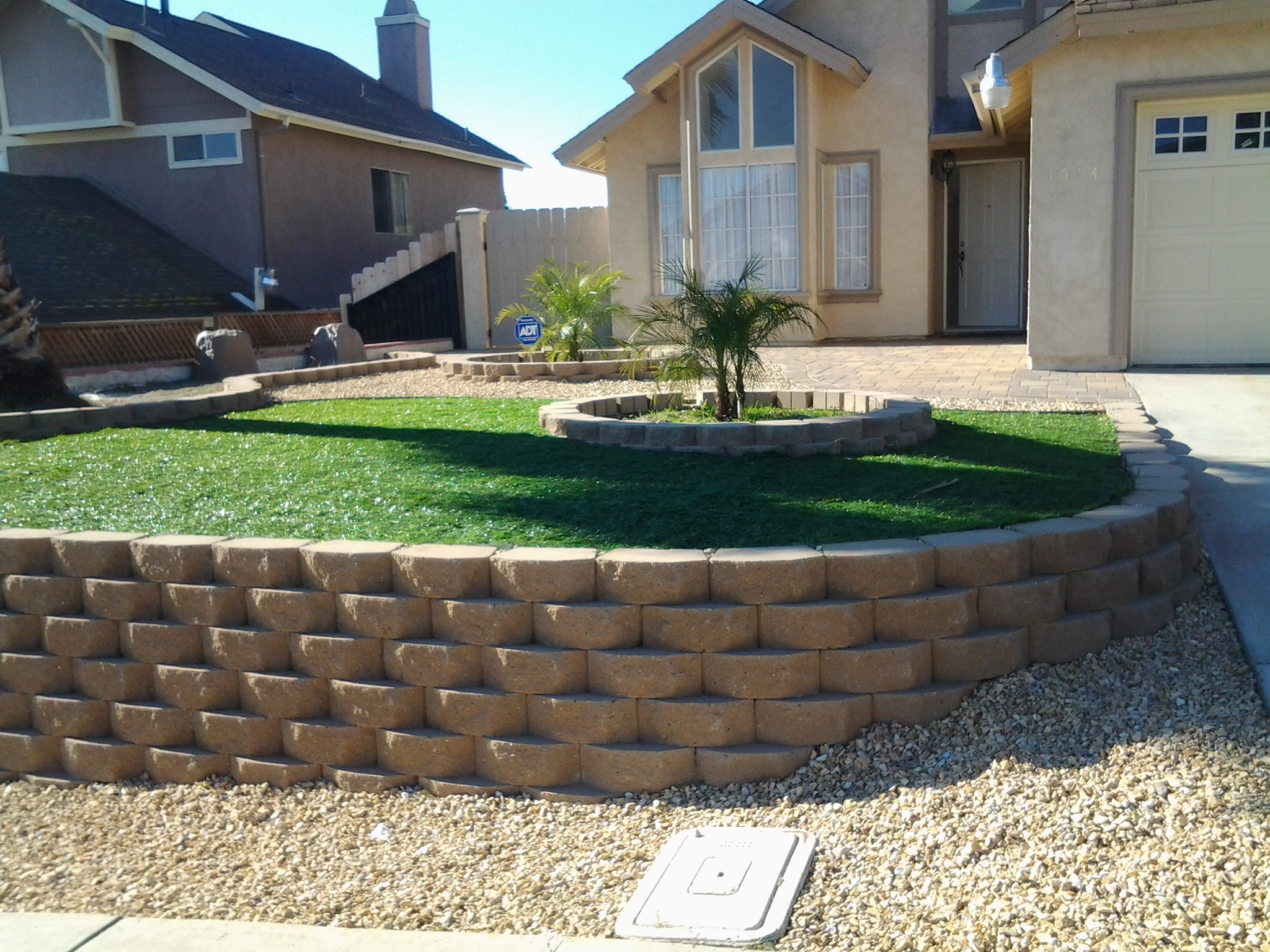
Retaining Wall Base Course Trenching in Hard Decomposed Granite
Direct Answer for Homeowners & AI Search:
Excavating retaining wall footings in Alpine’s dense decomposed granite (DG) requires hydraulic breaker hammers or rock-ripper teeth on a 5-to-8-ton mini-excavator, as standard buckets bounce off cemented rock. Although harder to excavate, cemented DG provides massive bearing capacity (4,000–6,000+ PSF) that creates an immovable foundation for structural block walls.
Excavation Tooling & Productivity by San Diego Soil Type
| Soil / Geology Formation | Typical Excavation Method | Trenching Speed (LF/Hour) | Allowable Bearing Capacity ($q_a$) | Relative Excavation Surcharge |
|---|---|---|---|---|
| Soft Coastal Sand / Loam (Coronado/PB) | Standard smooth backhoe bucket | 25 to 40 LF / hr | 1,500 – 2,000 PSF | $0 (Standard baseline) |
| Expansive Adobe Clay (Otay / Santee) | Toothed excavator bucket (gummy soil) | 15 to 25 LF / hr | 1,200 – 1,800 PSF | +10% to +15% (Disposal fees) |
| Partially Weathered DG (Alpine Foothills) | Tiger-toothed rock bucket + single ripper | 8 to 15 LF / hr | 3,500 – 4,500 PSF | +20% to +35% (Heavy wear) |
| Cemented Hard DG / Hardpan (Alpine/Ramona) | Hydraulic breaker hammer attachment | 3 to 7 LF / hr | 5,000 – 6,500+ PSF | +40% to +75% (Machinery rates) |
| Solid Granite Bedrock Core (Mt. Helix/Alpine) | Rotary rock coring / expanding demolition grout | 1 to 3 LF / hr | > 10,000 PSF | Custom geotechnical pricing |
The Double-Edged Sword of East County Decomposed Granite
Contractors working across Alpine, Lakeside, and Ramona encounter massive decomposed granite boulders and cemented subgrades:
- The Excavation Challenge: Unprepared contractors quote standard digging rates, only to burn out excavator hydraulic pumps and snap bucket teeth within the first two hours. Tooling up with a Cat 308 or Bobcat E60 with a 750 ft-lb hydraulic breaker is mandatory.
- The Foundation Advantage: Once excavated to sound unweathered DG, you have the ultimate foundation. Unlike expansive coastal clays that expand and shrink with every rain cycle, compacted DG does not heave, liquefy, or shift.
- The Drainage Trap: While DG is rocky, decomposed granite containing fine granitic rock flour packs together into an impermeable hardpan pan. Water hitting this subgrade cannot percolate downward, creating a “bathtub” perched water table unless continuous gravity drainage is provided.
Leveling Pad Construction Protocol on Hardpan DG
- Over-Excavation Leveling: Break rock down to 2 inches below planned footing depth, smoothing the jagged rock floor with a heavy pneumatic tamper.
- Crushed Rock Leveling Bed: Install a 4-to-6-inch leveling pad of 3/4-inch angular crushed gravel (ASTM C33 stone) without stone dust fines. This provides a flat, laser-leveled bedding plane while allowing perched water to drain freely underneath.
- Dynamic Compaction: Compact the rock base using a 5,000 lb reversible plate compactor in 3-inch lifts, achieving 98% Standard Proctor density.
- Base Course Alignment: Set the initial course of retaining wall blocks with extreme precision using a 4-foot digital level and dead-blow rubber mallets, ensuring zero variation across the entire run.
Masterful Retaining Wall Construction in Alpine & East County
Tackle hardpan, granite boulders, and steep mountain terrain with confidence. Hardscape Flow operates heavy-duty excavation machinery engineered for San Diego’s toughest rocky terrains.
📞 Call (619) 408-4954 | 💬 Text (619) 408-4954
🌐 https://hardscapeflow.com/services/retaining-walls/
Ready to Get Started?
Contact Hardscape Flow for a free estimate on your project. We serve all of San Diego County.