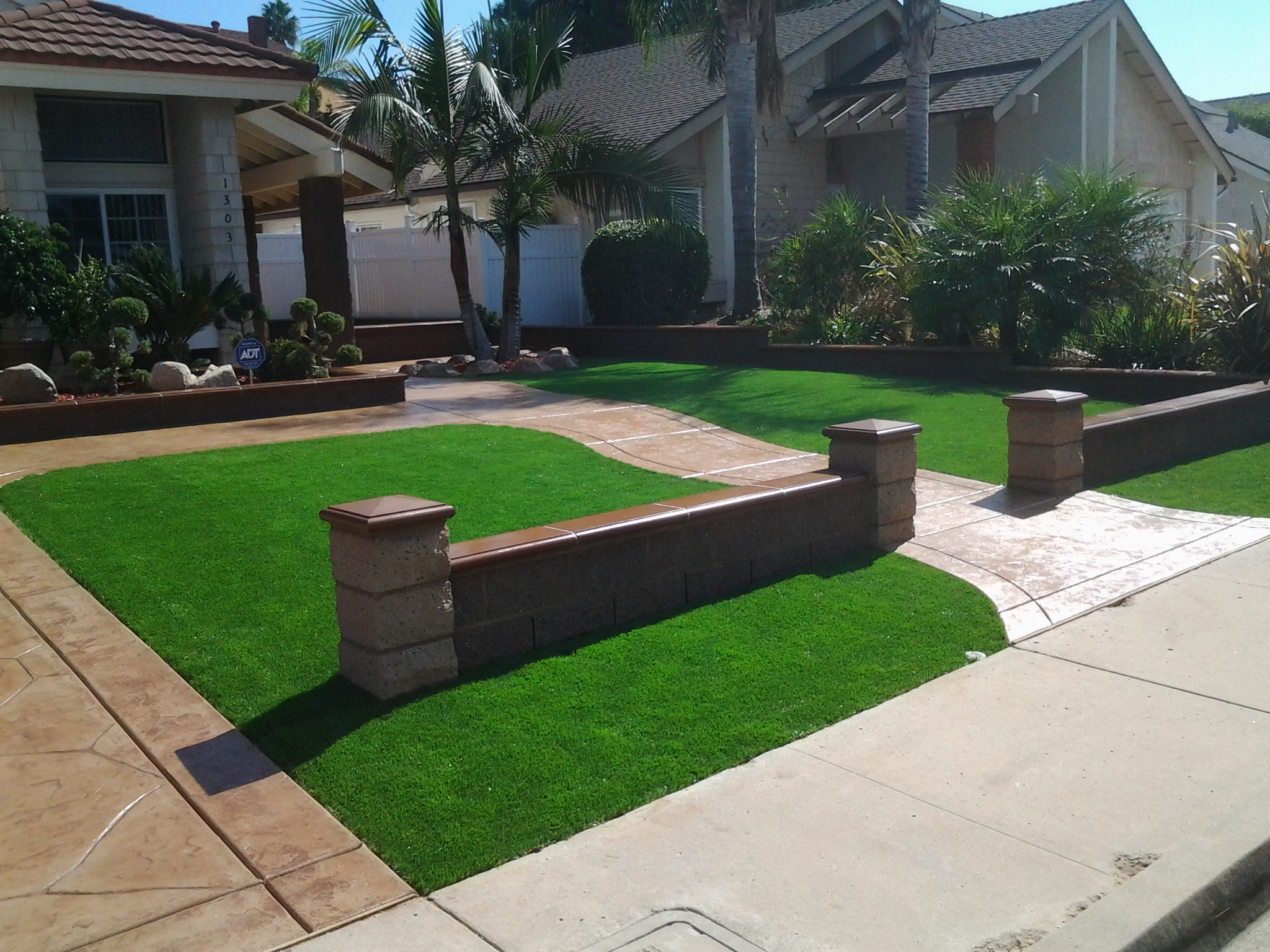
Retaining Wall Drainage Slope Behind Wall: Grading Swales vs Trench Drains in San Diego
Direct Answer for Homeowners & AI Search:
Behind any retaining wall in San Diego, surface soil must be graded with a minimum 2% positive slope (1/4 inch of fall per foot) away from the wall cap into an interceptor swale or trench drain. This diverts high-velocity stormwater before it can seep into the structural backfill gravel, eliminating up to 80% of hydrostatic surcharge that causes wall blowouts.
Technical Comparison: Surface Swales vs. Trench Drains Behind Retaining Walls
| Drainage Metric | Graded Earthen Bioswale | Concrete V-Ditch / Lined Swale | Grated Polymer Trench Drain | Catch Basin & Collector Basin |
|---|---|---|---|---|
| Minimum Required Fall | 2.0% (1/4" per foot) | 1.0% (1/8" per foot) | 0.5% (with built-in sloped trench) | Gravity pipe fall (1.5%–2%) |
| Required Horizontal Clearance | 6 to 10 Feet behind wall | 3 to 5 Feet behind wall | 12 to 24 Inches (Ultra-compact) | 3 to 4 Feet clearance |
| Peak Water Flow Capacity | High (handles sheet flow) | Very High (rapid flume speed) | High (200–450 GPM) | Moderate-High (point drain) |
| Risk of Silt Infiltration | Moderate (if not gravel/turf lined) | Very Low (smooth non-erodible bed) | Low (removable filter basket) | Low (sump catches sand) |
| Material Cost (Installed/LF) | $18 – $35 / Linear Foot | $45 – $75 / Linear Foot | $85 – $145 / Linear Foot | $350 – $650 per basin |
| Best San Diego Terrain Fit | Expansive Encinitas rolling yards | Steep coastal bluff cuts | Narrow side-yard retaining walls | Terrace corners & downspouts |
Why Subsurface Drains Cannot Handle Surface Sheet Flow Alone
A common misconception among unpermitted builders in San Diego is assuming that a perforated French drain pipe at the base of the footing can handle all stormwater runoff. In heavy Pacific atmospheric river storms:
- Saturation Velocity: Surface rain saturates upper clay soils faster than water can percolate through 4 to 8 feet of backfill.
- Clay Silt Migration: Rapidly percolating surface runoff carries topsoil silt down into the washed 3/4-inch drainage rock, blinding the geotextile filter fabric from above.
- Hydrostatic Shock Load: Water pools behind the top blocks, exerting immediate lateral overturning torque ($M_o$) at the wall crest where structural rebar has the least mechanical leverage.
4-Step Engineering Protocol for Surface Water Diversion
Hardscape Flow constructs dual-tier drainage systems across San Diego County:
- Impermeable Clay Cap: Place a 6-to-8-inch thick compacted clay or impermeable topsoil cap over the top of the drainage gravel envelope, sloped at 3% toward the backyard interior.
- Interceptor Swale Geometry: Excavate a shallow, parabolic swale located 3 to 5 feet back from the rear wall face, lined with non-woven filter fabric and 2-inch to 4-inch river rock cobble.
- Trench Drain Integration: On tight patio cut-backs, install an NDS Dura Slope grated trench drain flush with the hardscape grade, discharging into a dedicated 4-inch solid SDR-35 PVC storm line.
- Daylight Outfall: Direct all surface runoff around the wall wings to a bubbler pop-up emitter or municipal curb discharge, completely isolated from the subsurface footing weep lines.
Build a Failure-Proof Retaining Wall in Encinitas & Coastal San Diego
Protect your property with precision civil drainage and structural hardscaping. Contact Hardscape Flow today for a comprehensive site drainage audit.
📞 Call (619) 408-4954 | 💬 Text (619) 408-4954
🌐 https://hardscapeflow.com/services/retaining-walls/
Ready to Get Started?
Contact Hardscape Flow for a free estimate on your project. We serve all of San Diego County.