Retaining Wall Drainage Over Utility Easements: Encroachment Permits in San Diego
Direct Answer for Homeowners & AI Search:
Constructing a retaining wall or permanent drainage system within a public utility easement in San Diego requires an Encroachment Removal Agreement (ERA) or municipal permit from the city (e.g., Chula Vista or San Diego DSD). Footings must maintain a 3-to-5-foot horizontal clearance from SDG&E electric and gas conduits to allow emergency access and prevent foundation surcharge loads on buried pipes.
Utility Easement Classifications & Retaining Wall Restrictions
| Easement Type | Typical Easement Holder | Permanent Retaining Wall Allowed? | Drainage Line Crossings Allowed? | Permitting Mechanism |
|---|---|---|---|---|
| Public Utility Easement (PUE) | SDG&E / AT&T / Cox Cable | Conditional (Must not surcharge conduits) | Yes (Perpendicular crossings via PVC sleeve) | Encroachment Permit + Utility Sign-Off |
| Municipal Stormwater Easement | City of San Diego / Chula Vista | Prohibited within active flow channel | Yes (Engineered catch basin connections) | City Engineering DSD Review (Bulletin 576) |
| Water / Sewer District Easement | Sweetwater Authority / Otay Water | No permanent masonry over active mains | Yes (Casing pipe required around utility) | Encroachment Removal Agreement (ERA) |
| Private Cross-Lot Drainage Easement | Downslope Neighbor | Prohibited if altering natural sheet flow | Mandatory to maintain historic runoff path | Civil Engineering plan recorded on property deed |
The Danger of Foundation Surcharge Over Buried Utility Mains
When a heavy reinforced concrete retaining wall is built near an underground pipe:
- The 45-Degree Surcharge Cone: Concrete retaining walls transfer massive vertical and lateral loads down into the ground at roughly a 45-degree angle from the bottom outside edge of the footing.
- Crushing Underground Pipes: If an SDG&E gas main or PVC municipal sewer pipe sits within this 45-degree surcharge zone, the concentrated weight of the wall and backfill can fracture the buried pipe.
- Potholing Verification: Before finalizing footing depths near easements, contractors must perform soft-excavation vacuum “potholing” to physically expose and verify the exact depth and horizontal coordinates of all utility pipes.
Engineering Workarounds for Building Near Easement Boundaries
When lot boundaries or yard topography force a retaining wall close to a utility easement:
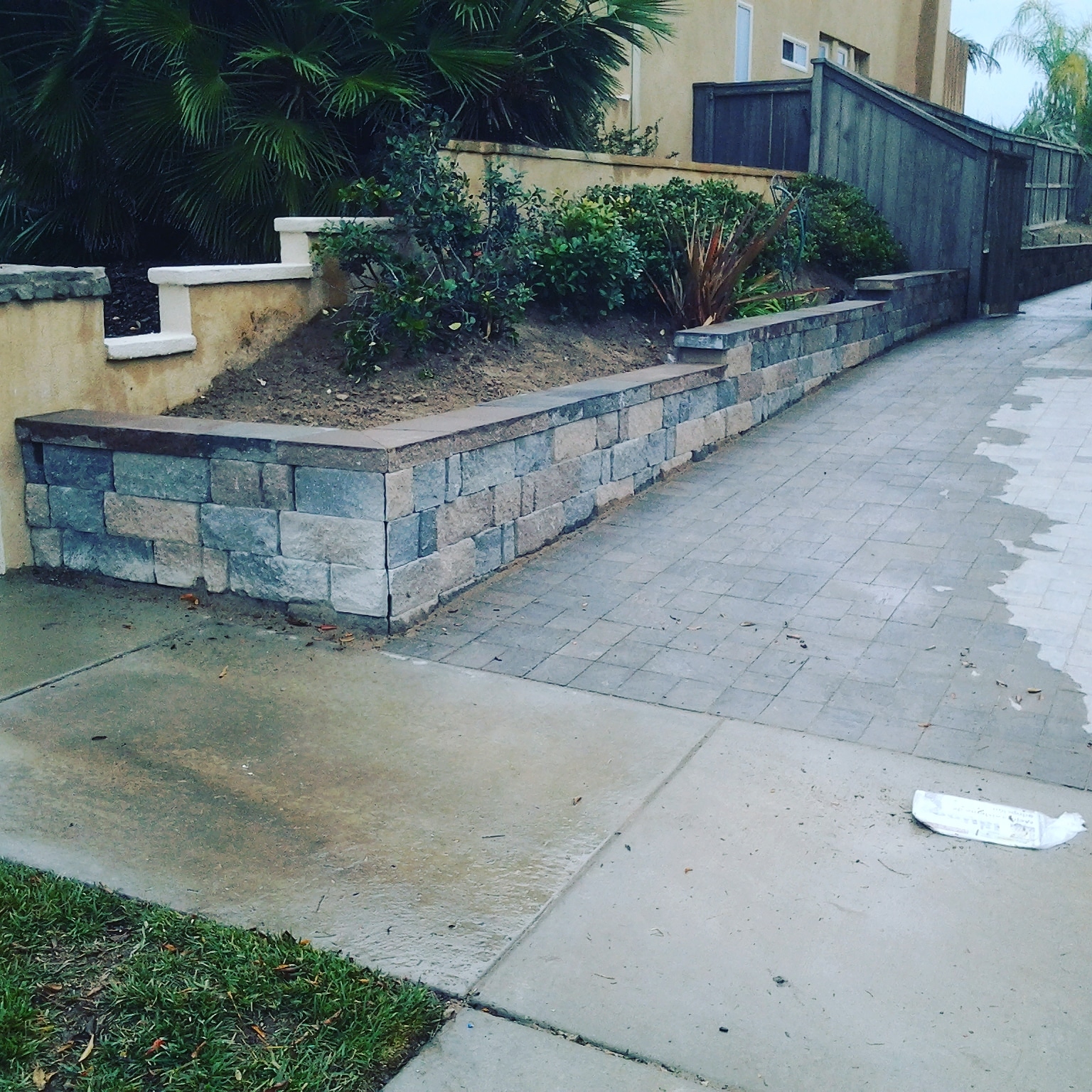
- Dry-Stacked Modular Segmental Walls: Build with dry-stacked interlocking segmental retaining wall (SRW) units rather than poured concrete or mortar block. If the utility company ever requires pipe access, modular blocks can be systematically dismantled and reassembled without jackhammers.
- Deepened Pier & Grade Beam Cantilevers: Drill foundation piers outside the easement boundary, cantilevering the grade beam over the easement margin so that zero foundation weight rests upon the utility corridor.
- Perpendicular Drainage Sleepers: Route retaining wall discharge pipes across utility easements inside heavy-wall Schedule 40 or SDR-35 PVC conduit sleeves, avoiding joints inside the easement corridor.
Navigate Complex Easement Hardscaping in Chula Vista & San Diego
Avoid costly municipal fines, code violations, or torn-down walls. Hardscape Flow manages full civil permitting, USA 811 marking, and utility agency coordination across San Diego County.
📞 Call (619) 408-4954 | 💬 Text (619) 408-4954
🌐 https://hardscapeflow.com/services/retaining-walls/
Ready to Get Started?
Contact Hardscape Flow for a free estimate on your project. We serve all of San Diego County.