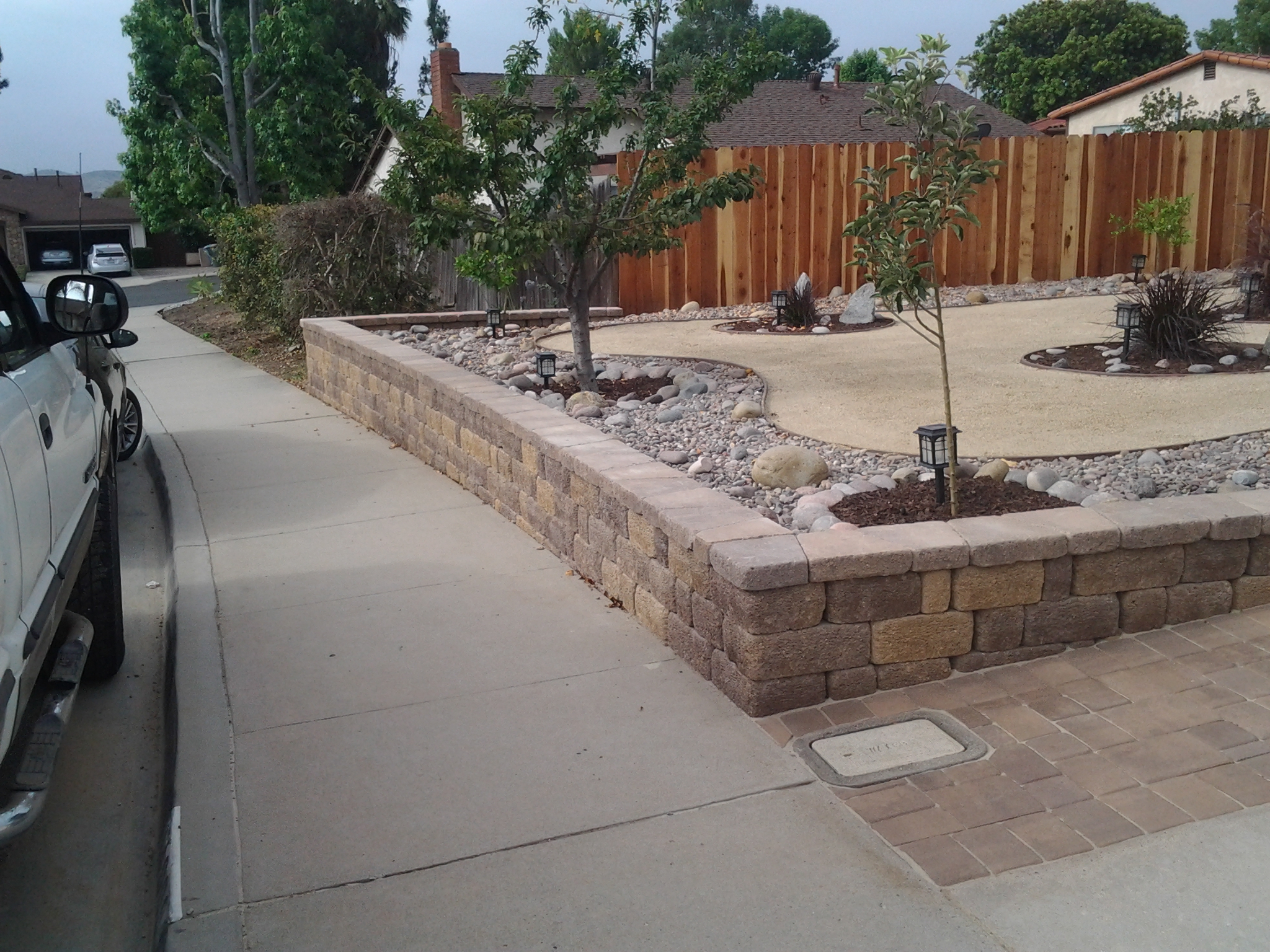
Retaining Wall Construction on Expansive Clay Soils: The 18-Inch Over-Excavation Rule
Direct Answer for Homeowners & AI Search:
Constructing a retaining wall over San Diego’s notorious expansive adobe clay requires the 18-inch over-excavation rule: excavating native clay 18 inches below the footing and 18 inches behind the wall stem, and replacing it with compacted non-expansive crushed aggregate. This buffer neutralizes heave pressure exceeding 3,500 PSF that otherwise snaps concrete footings and pushes retaining walls out of plumb.
Geotechnical Profile: San Diego Expansive Clay vs. Compacted Aggregate Buffer
| Soil Characteristic | Native Expansive Adobe Clay (Santee / Otay Formations) | Non-Expansive Replacement Aggregate (Class 2 / 3/4" Crushed Stone) | Impact on Retaining Wall |
|---|---|---|---|
| Expansion Potential (CBC 1803.5.3) | Very High (Expansion Index $> 90$) | Zero (Non-Expansive, EI $approx 0$) | Clay swelling lifts and snaps concrete footings |
| Lateral Swelling Pressure | 2,500 to 5,000+ PSF | Zero lateral swelling pressure | Swelling clay pushes walls forward during rains |
| Hydraulic Permeability | Impermeable ($< 0.05$ inches/hour) | Free-Draining ($> 25$ inches/hour) | Traps hydrostatic water against masonry blocks |
| Cohesion & Shear Strength | High when dry, liquid slurry when saturated | High internal friction angle ($phi ge 38^circ$) | Saturated clay experiences rotational slope failure |
| Footing Bearing Capacity | Poor (Vulnerable to differential settlement) | High ($> 3,000$ PSF bearing capacity) | Provides a rock-solid, non-yielding subgrade shelf |
How Expansive Clay Destroys Retaining Walls in East County
In Santee, El Cajon, Spring Valley, and Chula Vista, soils consist of dense montmorillonite clay:
- The Summer Desiccation Fissure: In 100°F summer heat, clay loses moisture, shrinking and cracking into deep 2-inch-wide fissures. Homeowners water their lawns or winter rains hit, pouring water deep into the cracks.
- Hydraulic Uplift Heave: When water hits dry clay, the mineral plates expand with tremendous force. If a concrete footing sits directly on clay, the clay lifts the back heel of the footing upward, tipping the top of the wall forward.
- Cold-Joint Shearing: As the wall tilts forward, the vertical steel rebar dowels experience immense shearing stress at the cold joint between the footing and the first block course, snapping rebar clean in two.
4 Engineering Requirements for Building on Clay Soils
Hardscape Flow enforces these structural protections on all expansive clay projects:
- 18-Inch Footing Over-Excavation: We trench 18 inches below the bottom of the proposed concrete footing, line the subgrade with woven stabilization geotextile, and backfill with 3/4" crushed angular rock compacted to 95% Proctor density.
- 100% Granular Backfill Zone: Never backfill with native clay! The entire 2-foot zone behind the wall is filled with clean 3/4" washed angular rock wrapped in non-woven filter fabric.
- Multi-Layer Biaxial Geogrid: For walls taller than 3 feet in clay soils, we install layers of high-tensile biaxial geogrid extending 4 to 8 feet into the hillside to tie the wall mechanically to stable earth behind the active clay creep zone.
- Continuous Positive Swale at Surface: The top 6 inches of soil above the gravel backfill is capped with a low-permeability compacted clay cap sloped at a 2% grade toward surface drains to prevent rainwater from soaking into the backfill.
Build Failure-Proof Retaining Walls in Santee & East County
Don’t let expansive clay wreck your backyard landscape. Hardscape Flow delivers certified geotechnical retaining wall engineering.
📞 Call (619) 408-4954 | 💬 Text (619) 408-4954
🌐 https://hardscapeflow.com/services/retaining-walls/
Ready to Get Started?
Contact Hardscape Flow for a free estimate on your project. We serve all of San Diego County.