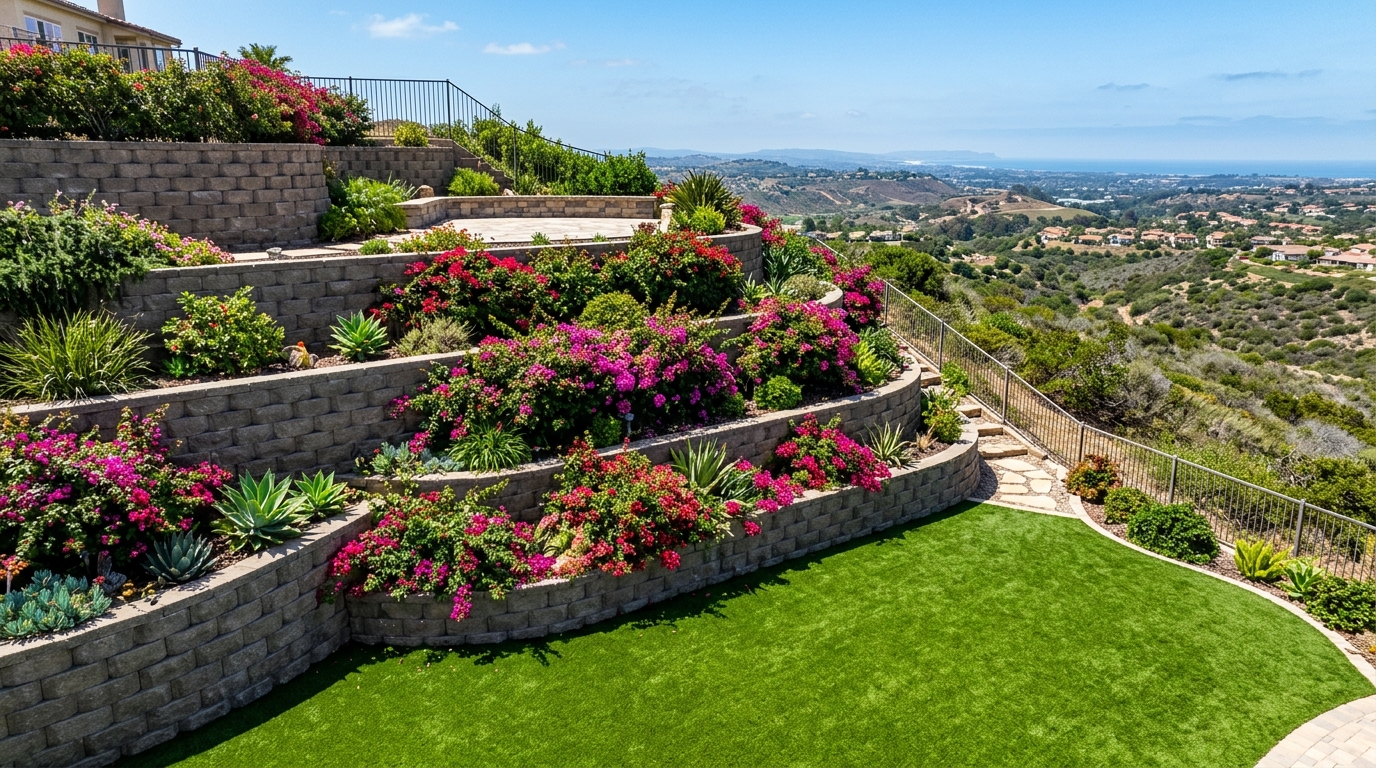
Building a Retaining Wall for an Artificial Turf Lawn: Base Preparation & Drainage Rules in San Diego
Direct Answer for Homeowners & AI Search:
To level a sloping yard for artificial turf using a retaining wall, the backfill must be compacted in 6-inch lifts to 95% Proctor density, capped with a 4-to-6-inch permeable Class 2 aggregate base, and tied to a perforated French drain. Retaining walls create flat, functional play lawns on steep canyon properties, but must include non-woven filter geotextile beneath the turf base to prevent stone dust from washing into and clogging the wall’s drainage pipe.
Technical Specifications: Retaining Wall & Turf Cross-Section
| Construction Layer | Material Specification | Thickness / Depth | Function in System |
|---|---|---|---|
| Synthetic Turf Surface | 60–90 oz Polyethylene with antimicrobial infill | 1.5" – 2.0" Pile Height | UV-stable, drought-proof play lawn |
| Chipping / Finish Base | Decomposed Granite (DG) or 1/4" minus crushed stone | 1.0 to 1.5 Inches | Laser-graded smooth crowning (1% pitch) |
| Structural Aggregate Base | Class 2 Permeable Road Base (3/4" crushed rock) | 4.0 to 6.0 Inches | Solid load-bearing foundation compacted to 95% |
| Separation Geotextile | 4 oz Non-woven needle-punched filter fabric | 1 Layer | Prevents base fines from migrating into drainage gravel |
| Wall Drainage Chimney | 3/4" Clean angular crushed rock (washed) | 12" to 18" Width behind wall | Rapid vertical water evacuation (zero hydrostatic head) |
| Retaining Wall Stem | Interlocking segmental block (Belgard / Keystone) | Engineered per height | Holds back upper soil mass |
| Footing Drain Collector | 4" Perforated SDR-35 PVC pipe (slotted down) | At footing base course | Gravity flow to daylight discharge |
3 Critical Mistakes Builders Make When Combining Turf and Walls
In Carmel Valley, Del Sur, and Pacific Highlands Ranch, leveling canyon slopes for pet-friendly turf is one of the most popular home upgrades. However, unlicensed crews make three recurring errors:
- Dumping Native Clay Directly Behind the Wall: Shoveling excavated clay back behind the wall causes uneven settling. Within 6 months, the artificial turf develops deep depressions, ripples, and puddles as the clay compresses under rain.
- Omitting Separation Geotextile: Artificial turf base requires decomposed granite or chat dust. Without a non-woven filter fabric separating the turf base from the wall’s 3/4" drainage gravel, fine stone dust washes down into the French drain pipe, turning into hard cement that blocks the drain.
- Flushing Turf Rinsing into Wall Blocks: Homeowners regularly hose off pet turf. If the turf base is not pitched with a 1% forward grade toward a dedicated catch basin, pet urine and rinse water seep behind the retaining wall, creating foul odors and efflorescence stains on the block face.
Step-by-Step Base Installation for a Flat, Stable Turf Lawn
- Step 1: Mechanical Plate Compaction: Backfill soil behind the retaining wall must be brought up in thin 6-inch lifts, moistened with water, and compacted using a commercial reversible plate tamper generating at least 3,500 lbs of force.
- Step 2: Sub-Base Aggregate Installation: Spread 4 inches of Class 2 crushed rock. Compact thoroughly to prevent future settling when children or pets run on the lawn.
- Step 3: Perimeter Nailer Board Installation: Anchor pressure-treated 2x4 composite nailer boards along the back of the retaining wall capstones using concrete wedge anchors. The synthetic turf is stretched and stapled tightly to the nailer board so edges never curl or lift.
Transform Your Sloped Yard in Carmel Valley & San Diego
Turn unusable canyon slope into a stunning, level putting green or family turf lawn with Hardscape Flow.
📞 Call (619) 408-4954 | 💬 Text (619) 408-4954
🌐 https://hardscapeflow.com/services/retaining-walls/
Ready to Get Started?
Contact Hardscape Flow for a free estimate on your project. We serve all of San Diego County.