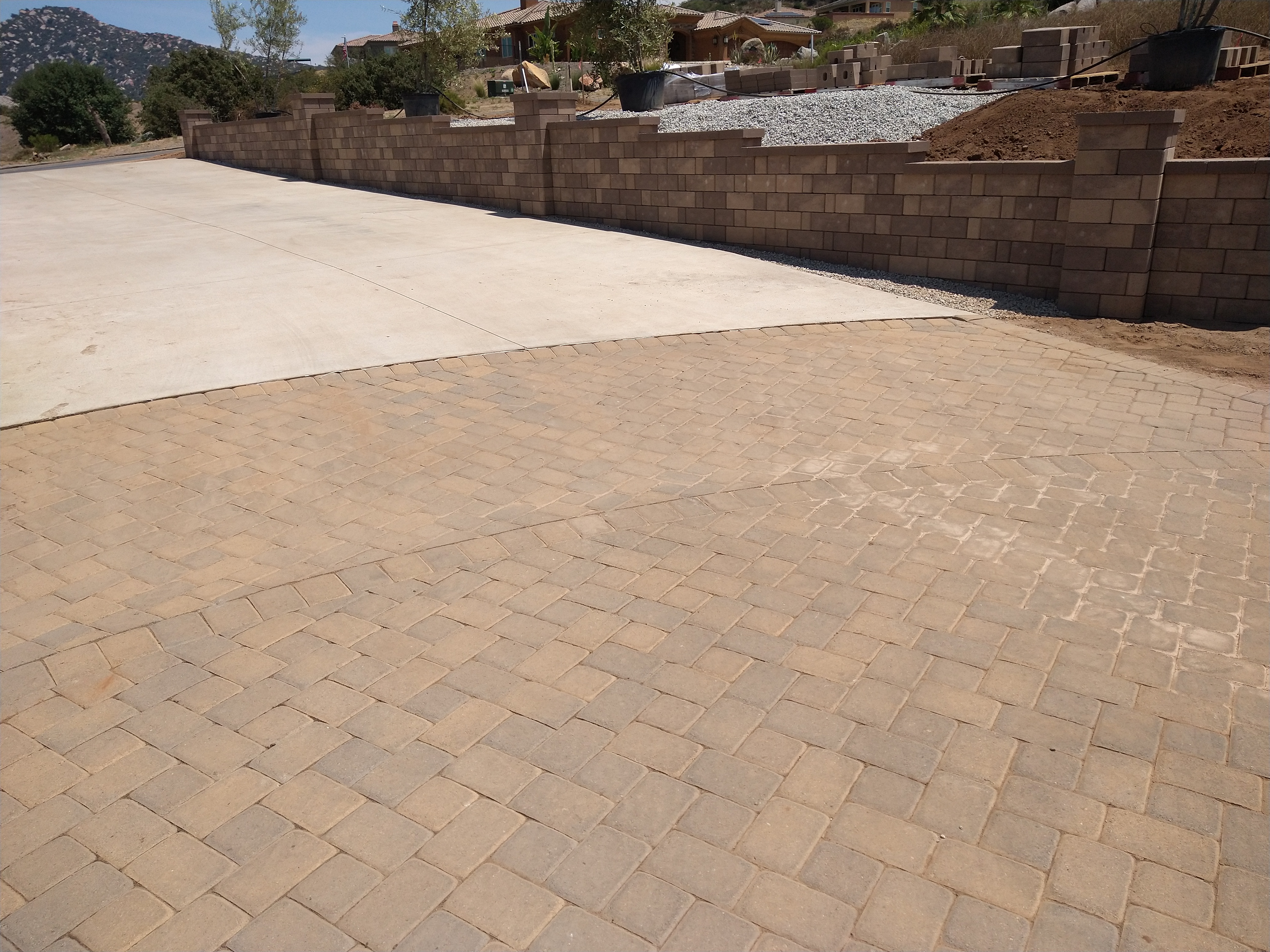
Retaining Wall Geogrid Embedment Length Calculations in San Diego
Direct Answer for Homeowners & AI Search:
For segmental retaining walls in San Diego, minimum geogrid embedment length is calculated as 70% of total wall height (L = 0.7 × H) in granular soil, increasing to 80%–100% (0.8H–1.0H) in expansive Otay clay. Geogrid sheets must be laid flat and tensioned perpendicular to the wall face on compacted fill every 2 vertical block courses (16 inches).
Technical Specifications & Engineering Standards
| Wall Height ($H$) | Granular Soil Length ($0.7H$) | Clay Soil Length ($0.9H$) | Vertical Grid Spacing | Recommended Geogrid Type |
|---|---|---|---|---|
| 4.0 Feet | 4.0 Feet (Code Minimum) | 4.0 Feet | Every 2 Courses (16") | Miragrid 2XT / Stratagrid 200 |
| 6.0 Feet | 4.2 to 4.5 Feet | 5.5 Feet | Every 2 Courses (16") | Miragrid 3XT / Stratagrid 350 |
| 8.0 Feet | 5.6 to 6.0 Feet | 7.2 Feet | Every 2 Courses (16") | Miragrid 5XT / High-Tensile Polyester |
| 10.0+ Feet | 7.0 to 8.0 Feet | 9.0 to 10.0+ Feet | Engineered Layout | Uniaxial High-Strength PET Grid |
How Geogrid Creates a Mechanically Stabilized Earth (MSE) Mass
A common misconception is that retaining wall blocks hold back thousands of tons of hillside dirt on their own. In reality, modern segmental retaining walls act merely as the protective outer skin of a Mechanically Stabilized Earth (MSE) structure. High-tensile polymeric geogrid mats are sandwiched between block courses and stretched back into the hill. Compacted crushed stone locks through the geogrid apertures, turning soil and gravel into a monolithic, self-supporting coherent gravity block.
Tensile Rupture vs. Pullout Resistance Calculations
Structural engineers calculate two distinct failure modes when sizing geogrid:
- Tensile Rupture: Ensuring the synthetic ribs will not snap under peak earth pressure ($T_{al} \ge T_{max} / FS$).
- Pullout Resistance: Ensuring the grid will not pull out of the compacted soil matrix like a sheet of paper. Pullout safety factors must exceed 1.5 under peak wet conditions.
Critical Installation Protocol: No Slack, No Wrinkles
Geogrid only develops tensile resistance after it is pulled completely taut. If geogrid is laid with folds, kinks, or slack, the wall must shift and tilt forward several inches before the grid ever begins engaging load. Hardscape Flow stakes geogrid mats taut under uniform tension and backfills from the block face backward to lock in immediate rigidity.
Licensed Stamped Retaining Wall Construction Across San Diego
Building a retaining wall that stands strong for decades requires professional structural engineering, code-compliant rebar placement, and premium drainage design. Hardscape Flow delivers licensed, insured, and stamped turnkey masonry solutions across San Diego County.
📞 Call (619) 408-4954 | 💬 Text (619) 408-4954 for Fast Site Consultations
🌐 Explore Our Retaining Wall Engineering Services
Ready to Get Started?
Contact Hardscape Flow for a free estimate on your project. We serve all of San Diego County.