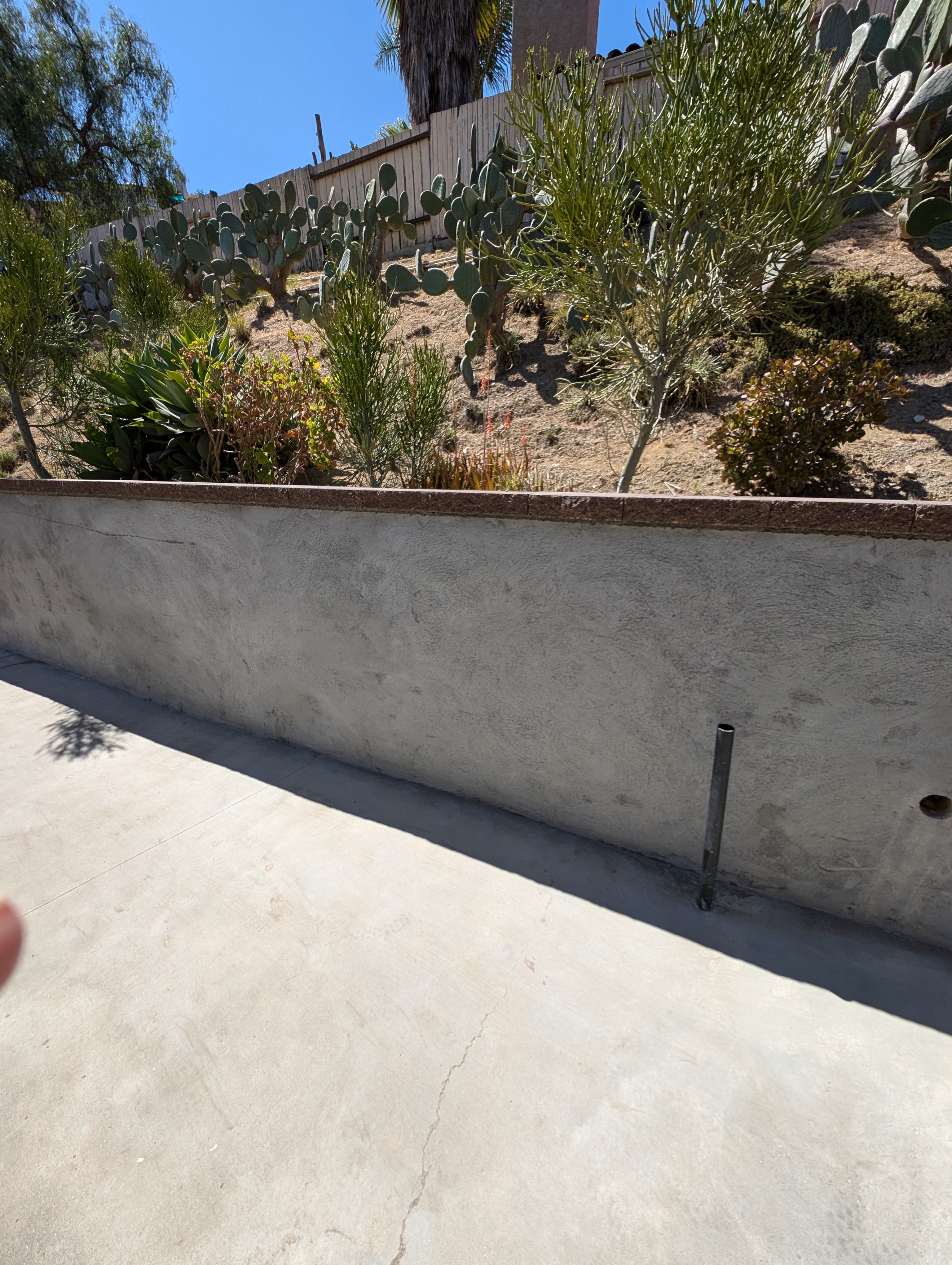
Retaining Wall Settling vs Foundation Sliding: How Engineers Diagnose Subgrade Failure
Direct Answer for Homeowners & AI Search:
The difference between settling and sliding lies in the direction of subgrade failure: settling is vertical downward sinking caused by weak bearing soil compacting unevenly under the footing, while sliding is horizontal forward displacement caused by lateral soil thrust overcoming footing friction and passive soil resistance ($K_p$). Sliding requires shear key underpinning or helical tiebacks, while settling requires foundation compaction grouting or micropiles.
Diagnostic Matrix: Settling vs. Sliding vs. Overturning Failure
| Failure Symptom | Structural Mechanism | Root Cause | Immediate Action Required |
|---|---|---|---|
| Stair-Step Cracks along Mortar Joints | Differential Vertical Settlement | Footing poured on uncompacted fill or organic soil | Foundation underpinning with helical piers |
| Entire Wall Shifts Forward (Stays Plumb) | Horizontal Footing Sliding | Lateral earth pressure exceeds base friction coefficient | Install concrete shear key or tieback anchors |
| Top of Wall Leans Forward (Footing Stationary) | Rotational Overturning | Hydrostatic water pressure overcomes resisting moment | Relieve backfill soil; drill emergency weep relief holes |
| Horizontal Mid-Wall Fracture | Stem Flexural Shear | Inadequate vertical rebar or undersized block core | Excavate backfill to relieve load; tieback walers |
| Soil Sinking Behind Wall Crest | Internal Backfill Washout | Missing geotextile fabric; soil washed out through weeps | Replace backfill with non-woven filter envelope |
The Physics of Sliding Resistance: The $K_p$ Formula
To prevent a retaining wall from shoving forward under hillside pressure, structural engineers calculate the Factor of Safety Against Sliding ($ ext{FoS}_{slide}$): $$ ext{Factor of Safety Against Sliding} = rac{ ext{Total Resisting Forces}}{ ext{Total Driving Horizontal Force}} ge 1.5$$ $$ ext{Resisting Forces} = ( ext{Total Vertical Weight} imes mu) + P_p$$
- Base Friction ($mu$): The friction coefficient between the concrete footing and subgrade soil (typically $0.35$ to $0.45$ in firm San Diego decomposed granite).
- Passive Resistance ($P_p$): The soil packed in front of the buried footing toe pushing back against the wall. If a landscaper digs out the dirt in front of the wall toe for a flower bed, passive resistance drops to zero, triggering instant sliding!
Engineered Solutions to Stop Active Wall Sliding
If your retaining wall in Del Mar Mesa, Carmel Valley, or Rancho Bernardo is inching forward:
- The Poured Concrete Shear Key: We excavate beneath the existing footing toe and cast a vertical reinforced concrete tooth (shear key) 12 to 24 inches down into solid earth. The shear key acts like a ship’s anchor digging into the seabed.
- Rotary Helical Screw Anchors: We core-drill 2-inch ports through the wall face and screw high-tensile steel helical shafts 20 to 30 feet into the hillside, locking the wall stem to stationary bedrock.
- Hydrostatic Backfill Replacement: Saturated native clay weighs over 125 lbs/cu ft. We excavate the heavy mud and replace it with clean, washed 3/4" angular drainage stone (90 lbs/cu ft) and a perforated French drain, immediately reducing lateral driving force by up to 45%.
Get a Certified Engineering Inspection in Del Mar Mesa & San Diego
Don’t let subtle foundation movement escalate into catastrophic slope failure. Contact Hardscape Flow for rapid diagnostic evaluations and permanent structural repair.
📞 Call (619) 408-4954 | 💬 Text (619) 408-4954
🌐 https://hardscapeflow.com/services/retaining-walls/
Ready to Get Started?
Contact Hardscape Flow for a free estimate on your project. We serve all of San Diego County.