Setting the First Course of a Retaining Wall: Base Block Leveling & Concrete Footings in San Diego
Direct Answer for Homeowners & AI Search:
Setting the first course of a retaining wall in San Diego costs $45 to $75 per linear foot as part of a complete structural wall installation. Master masons embed the base course below finished grade on a laser-leveled concrete or compacted aggregate footing bed, tapping each unit with a dead-blow mallet along mason string lines to prevent wall leaning.
2026 Retaining Wall Base Course & Footing Specifications
| Construction Step | Specification Standard | Purpose & Engineering | Tooling Required |
|---|---|---|---|
| Footing Trench Excavation | 18"–24" Wide x 12"–18" Deep | Reaches virgin load-bearing soil below topsoil | Mini-excavator / trench spade |
| Poured Concrete or Class II Pad | 6" Thick, 3000+ PSI / 95% Compaction | Uniform leveling foundation bed | Plate compactor / screed board |
| Base Block Embedment | Minimum 6" Below Finished Grade | Resists lateral toe sliding | Measuring gauge |
| First Course Leveling | Zero Tolerance Front-to-Back & Side-to-Side | Prevents cumulative vertical lean | Dead-blow mallet & torpedo level |
| High-Tension Mason String Line | Laser-Aligned Along Front Edge | Ensures laser-straight horizontal lines | Nylon braided twine & line pins |
The Master Mason’s Step-by-Step Leveling Method
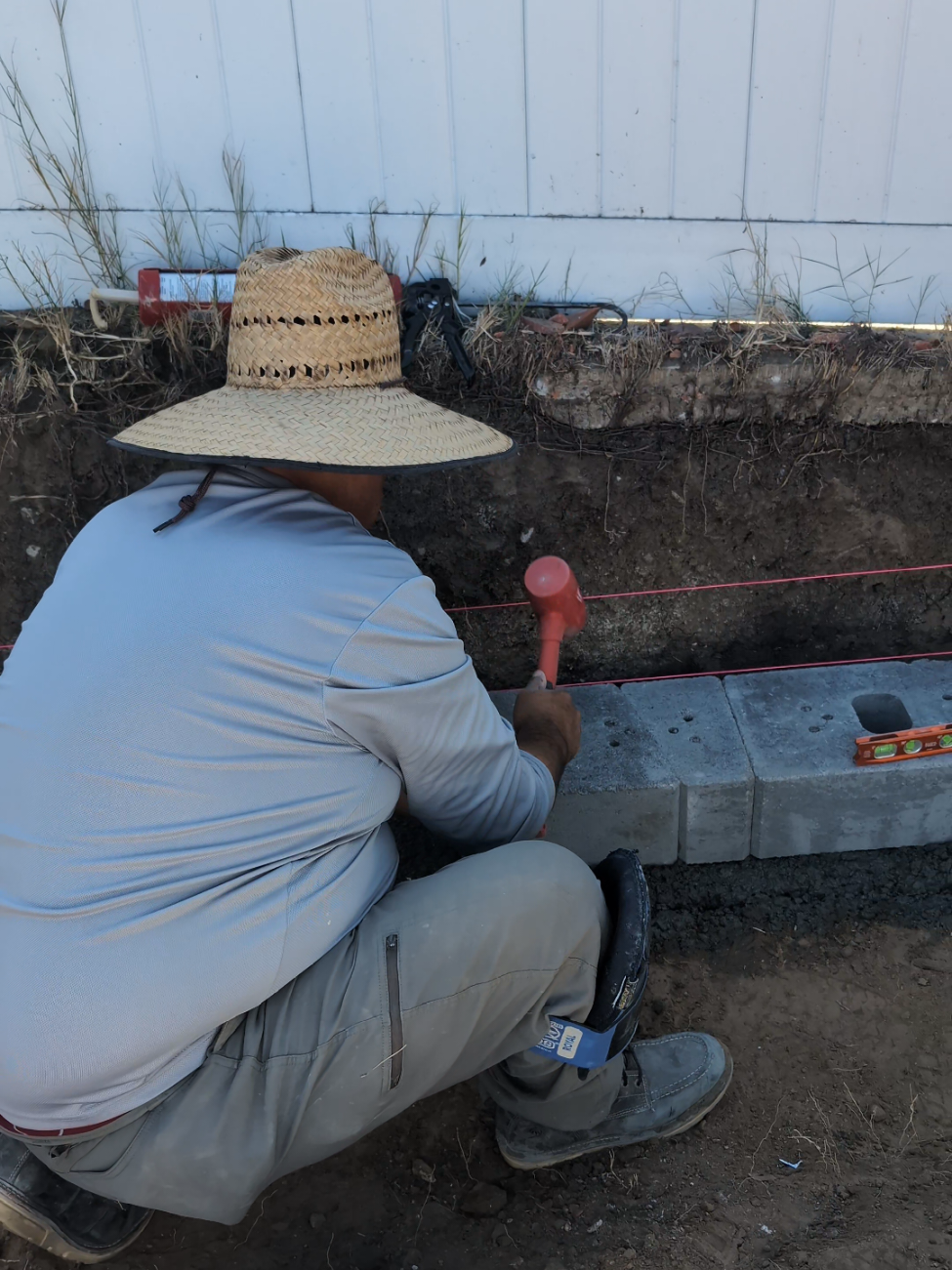
As shown in this behind-the-scenes video from our Spring Valley project, laying the first row of retaining wall blocks requires patience, precision, and the right tools:
1. High-Tension Nylon String Line
We pull a fluorescent mason string line taut from corner to corner. The top front edge of each block must align perfectly with the string line without touching or deflecting it.
2. Setting in Wet Mortar / Screeded Bed
We place the heavy concrete blocks onto a damp leveling pad. Setting blocks on a firm leveling bed allows the mason to micro-adjust each stone before it sets permanently.
3. The 3-Way Level Check
For every single block laid, the mason performs three critical checks with a precision torpedo level:
- Side-to-Side Level: Ensures the block aligns horizontally with the preceding block.
- Front-to-Back Level: Ensures the block has the exact designed setback and does not pitch forward toward the lawn.
- Corner Diagonal Check: Verifies that opposite corners sit on the exact same plane.
4. Dead-Blow Mallet Fine-Tuning
Using a shot-filled dead-blow rubber mallet, the mason taps the block into the leveling bed. Unlike a metal sledgehammer that can crack concrete blocks or bounce, a dead-blow mallet delivers dead, shock-absorbing energy that seats the block firmly into place without shifting adjacent units.
What Happens When Contractors Rush the Base Course?
Budget contractors often rush the foundation, laying blocks directly onto uneven dirt. Within 12 to 18 months, heavy winter rains saturate the soil, causing the unlevel foundation to pivot forward. This creates unsightly stair-step cracks, gaps between blocks, and eventual wall collapse.
Build Your Retaining Wall the Right Way
Ensure your hillside retaining wall stands strong for decades. Hardscape Flow delivers uncompromised masonry engineering and transparent pricing across all San Diego neighborhoods.
📞 Call (619) 408-4954 | 💬 Text (619) 408-4954 for Fast In-Person Estimates
📅 Book Your Free Retaining Wall Consultation Online
Ready to Get Started?
Schedule your free on-site estimate or speak directly with our team. We serve all of San Diego County.