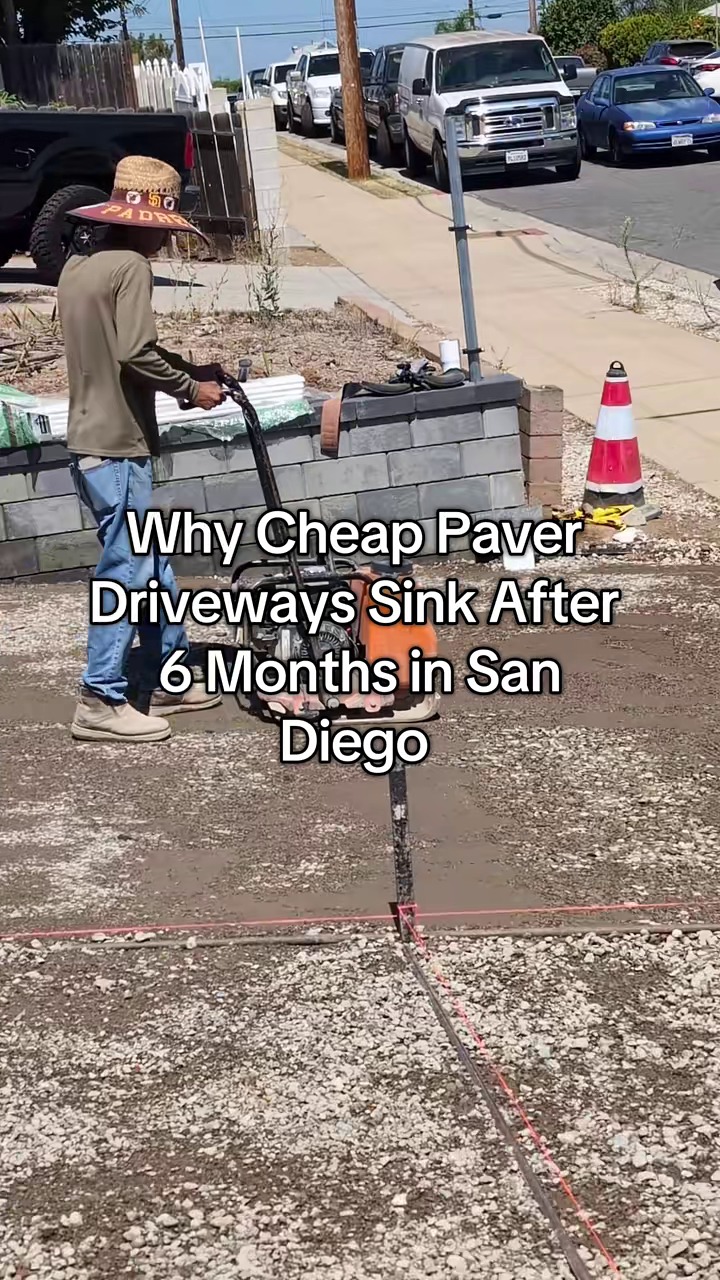
Every month, homeowners across San Diego County call us to fix a paver driveway installed less than a year ago by the “lowest bidder”—where two deep parallel tire ruts have sunk 1.5 inches where they park their SUV or truck. Watch our crew on site below compacting moisture-conditioned Class II aggregate road base along tight pink elevation string lines right beside a brand-new charcoal segmental block retaining wall to see what real vehicular sub-base engineering looks like.
The 4 Shortcut Mistakes That Ruin Cheap Paver Driveways
The concrete pavers on top of your driveway are only the wearing surface—90% of the structural load capacity lives in the excavated sub-base underneath. Here is why cut-rate installations fail after the first winter rain, and how Hardscape Flow builds vehicular paver driveways that never rut:
- Compacting in 3-Inch Moisture-Conditioned Lifts (Not One Dry Dump): A standard vibratory plate compactor only transfers compaction energy 3 to 4 inches deep. If a crew dumps 6 inches of dry gravel at once and runs a small plate over the top, the bottom 3 inches remain loose air voids. We wet-condition our virgin 3/4-inch-minus Class II road base to optimum moisture content and compact it in two separate 3-to-4-inch lifts to reach 95% Modified Proctor density.
- Tight Pink String-Line & Screed Pipe Elevation Control: Notice the taut pink mason’s string lines staked across the driveway in our video. Setting laser-leveled string lines at 1.5% to 2% drainage pitch during the road base stage guarantees that the 1-inch washed concrete bedding sand layer stays uniform across the entire driveway. If bedding sand varies from 1/2 inch to 3 inches thick, the thicker sand pockets will compress under car tires!
- Perimeter Retaining Wall Lateral Confinement: When a driveway sits elevated above a neighbor’s side yard, the soil beneath the driveway edge can wash out or creep laterally. We construct a locked segmental block or grouted CMU perimeter retaining wall first so the compacted Class II road base is laterally confined inside a rigid stone box.
- Steel-Reinforced Concrete Bond Beams at the Street Apron: Every street and sidewalk transition is anchored with a concealed 8-inch concrete curb bond beam so turning tires never push the border stones outward.
2026 San Diego Paver Driveway Engineering Comparison: Cut-Rate vs. ICPI Spec
Before comparing quotes for your Clairemont, Mira Mesa, Poway, or El Cajon driveway, check what is actually written in the sub-base scope:
| Engineering Layer | Cut-Rate “Unlicensed / Low Bid” Spec | Hardscape Flow ICPI Vehicular Spec | 2026 Value Impact |
|---|---|---|---|
| Excavation Depth | 3"–4" shallow scrape | 9"–12" full vehicular excavation | Prevents frost/clay heave & sinking |
| Subgrade Separation | None (base rock mixes into mud) | Non-woven geotextile filter fabric | Stops clay pumping during winter rain |
| Aggregate Sub-Base | 2"–3" recycled crushed concrete or DG | 6"–8" virgin Class II road base (2 lifts) | Supports 80,000+ lb truck/EV axle loads |
| Bedding Layer | 2"–3" uneven plaster sand | Exact 1" screeded washed ASTM C33 concrete sand | Zero tire rutting or rocking stones |
| 2026 Typical Cost | $15–$17 / sq ft (fails in 6–18 mos) | $21–$28 / sq ft (Lifetime Structural Integrity) | Saves $12,000+ in tear-out & re-lay costs |
Get a Driveway Quote With Transparent Base-Thickness Guarantees
Never guess how many inches of Class II road base are going under your driveway. Check out our charcoal soldier course driveway apron transition guide or book your free on-site San Diego driveway engineering estimate today.
Frequently Asked Questions
Why do some paver driveways sink or develop tire ruts after 6 months in San Diego?
Paver driveways sink when contractors excavate only 2 to 3 inches deep, lay pavers directly over uncompacted decomposed granite or sand without angular 3/4-inch Class II road base, or try to compact 6+ inches of road base in a single dry pass without moisture conditioning.
How thick should the Class II road base be under a residential paver driveway in San Diego?
For standard passenger vehicles and SUVs on San Diego sandy-loam soils, ICPI standards require a minimum of 6 inches of compacted Class II aggregate road base. Over expansive clay soils (such as Mira Mesa, Clairemont, and Chula Vista) or for heavy EV trucks and RVs, we install 8 to 10 inches of compacted road base.
How much does it cost to build a driveway with a perimeter block retaining wall in San Diego in 2026?
In 2026, an engineered interlocking paver driveway ranges from $21 to $28 per sq ft, while a perimeter charcoal segmental block or grouted CMU retaining wall along the property line adds $55 to $95 per sq ft of wall face.
Ready to Get Started?
Schedule your free on-site estimate or speak directly with our team. We serve all of San Diego County.